Developer tools · MongoDB
mongoui: an AI-augmented MongoDB client with the best UI/UX on the market
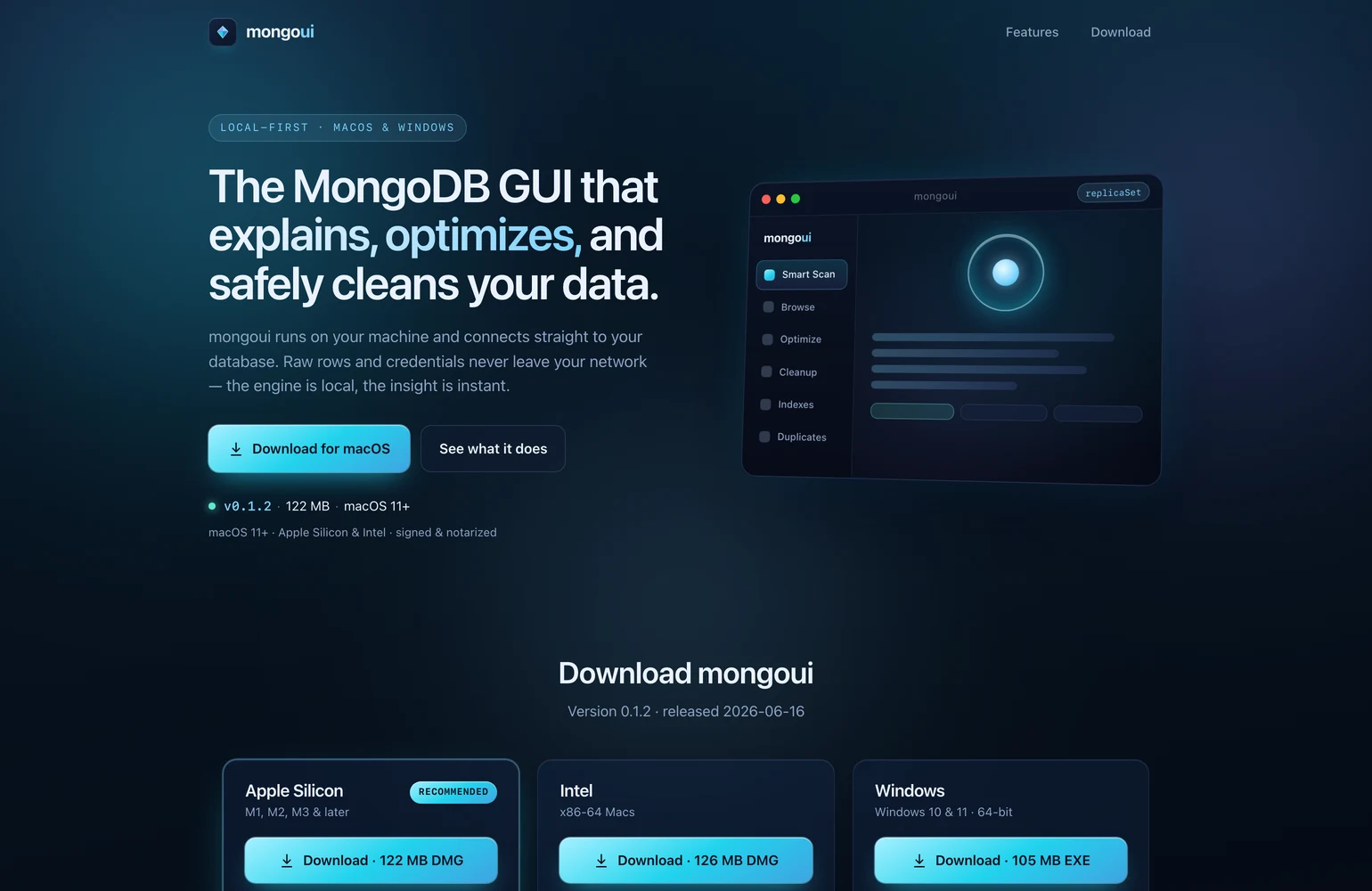
An AI-native Compass alternative that explains slow queries, measures the fix, and cleans data safely. The engine runs on your machine, so rows and credentials never leave it.
Inside the app
Product screens, step by step
Screens from the shipped app or live site. Some data is illustrative, but the interface shows the workflow we built.
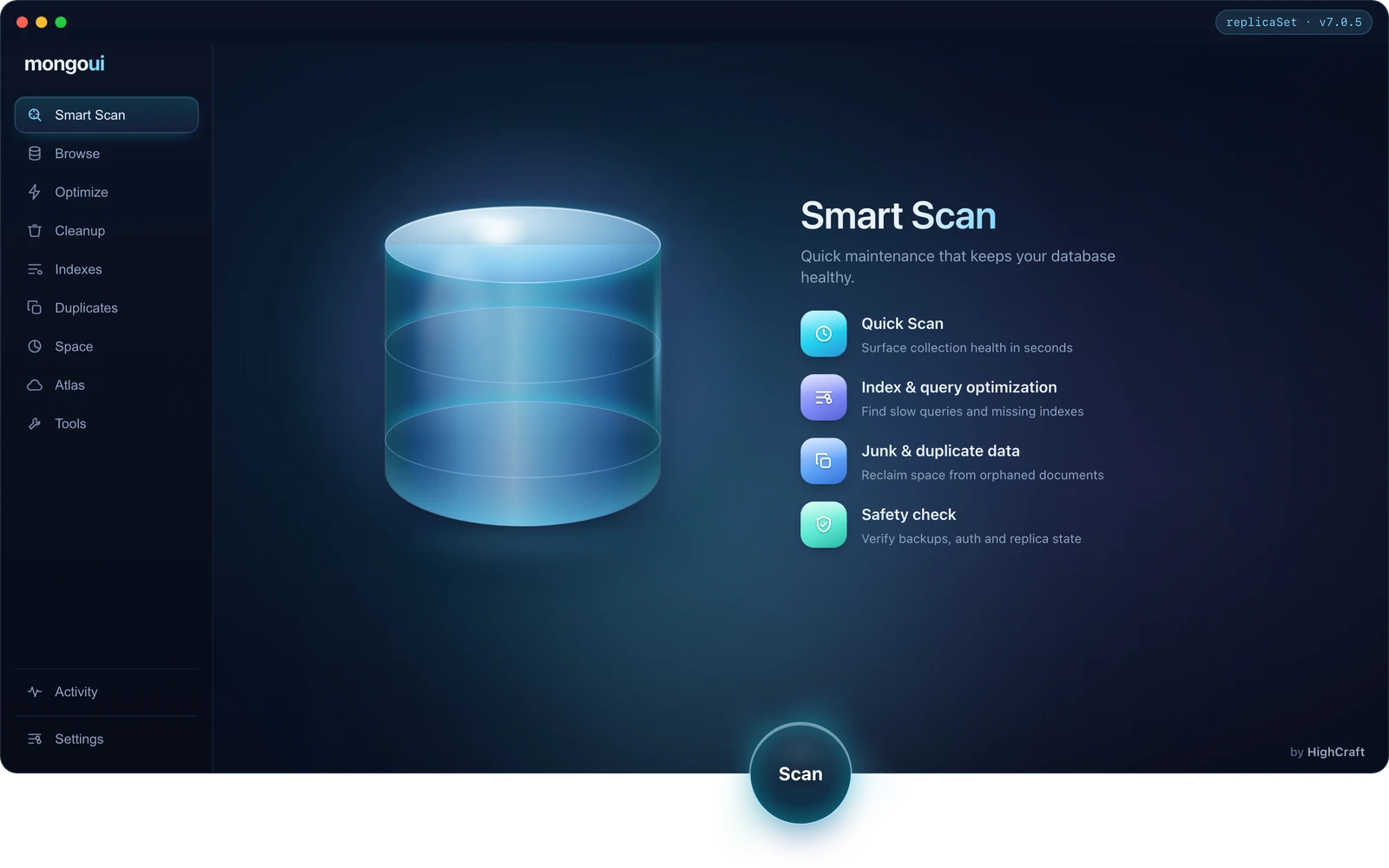
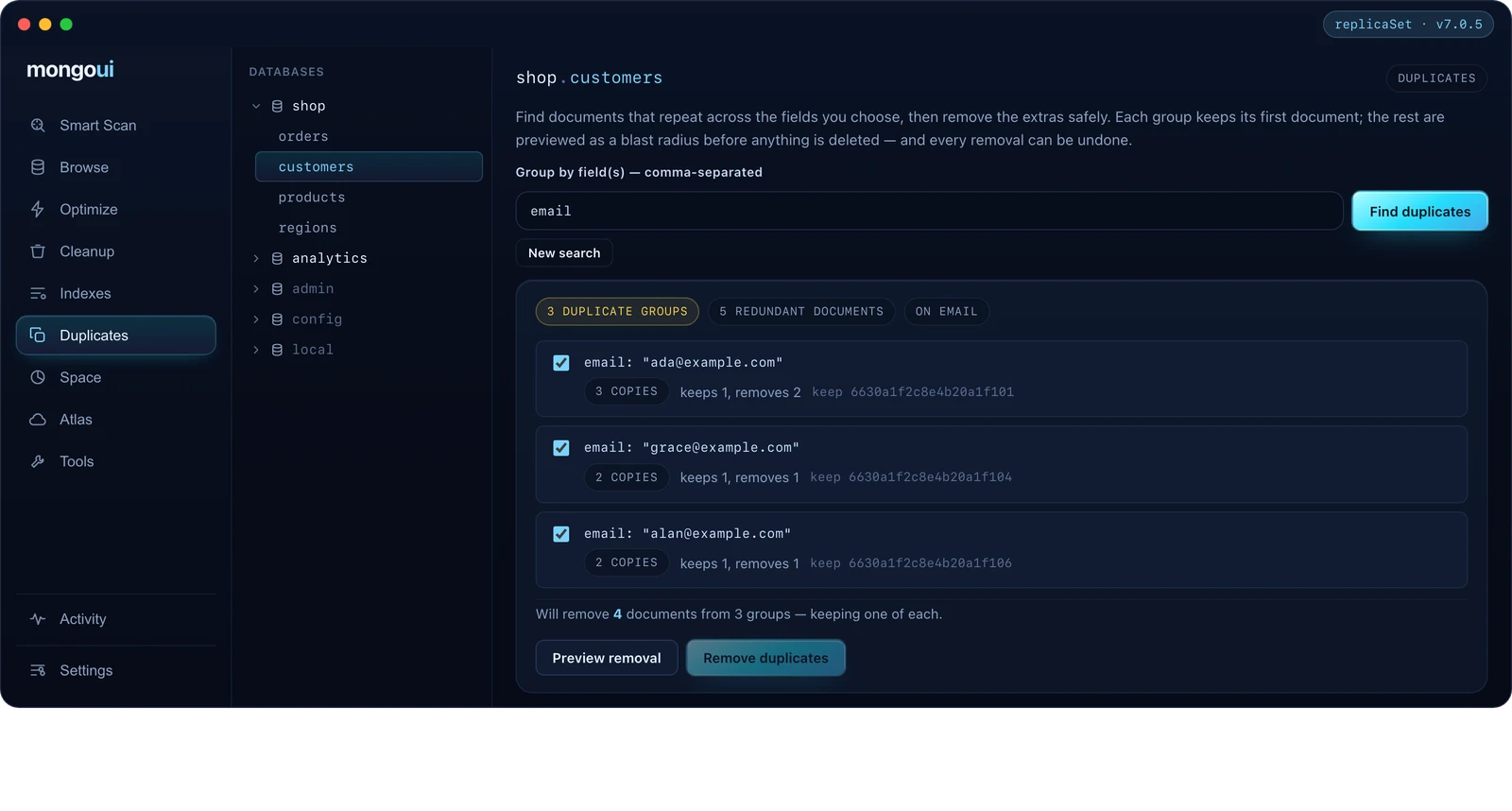
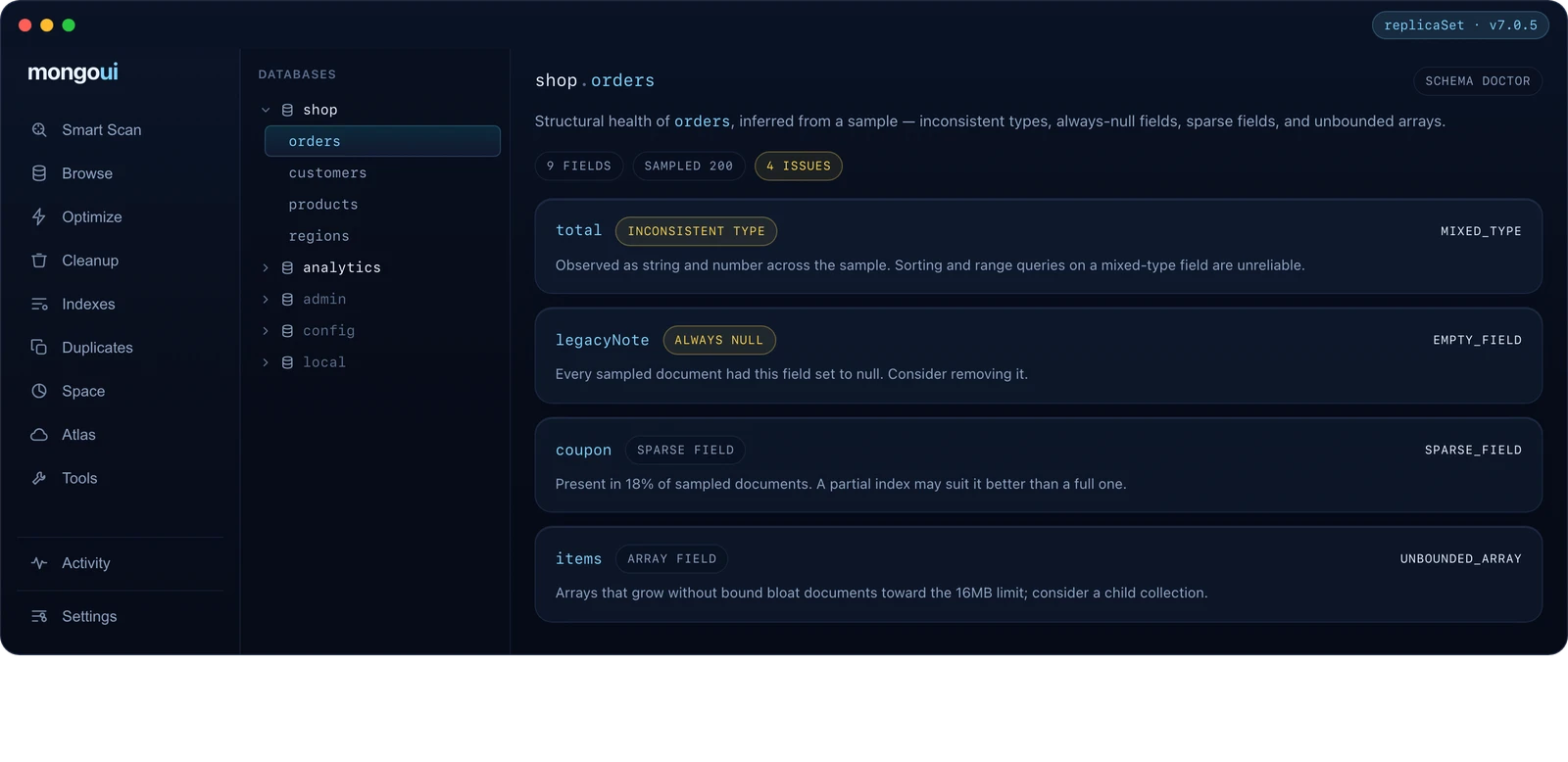
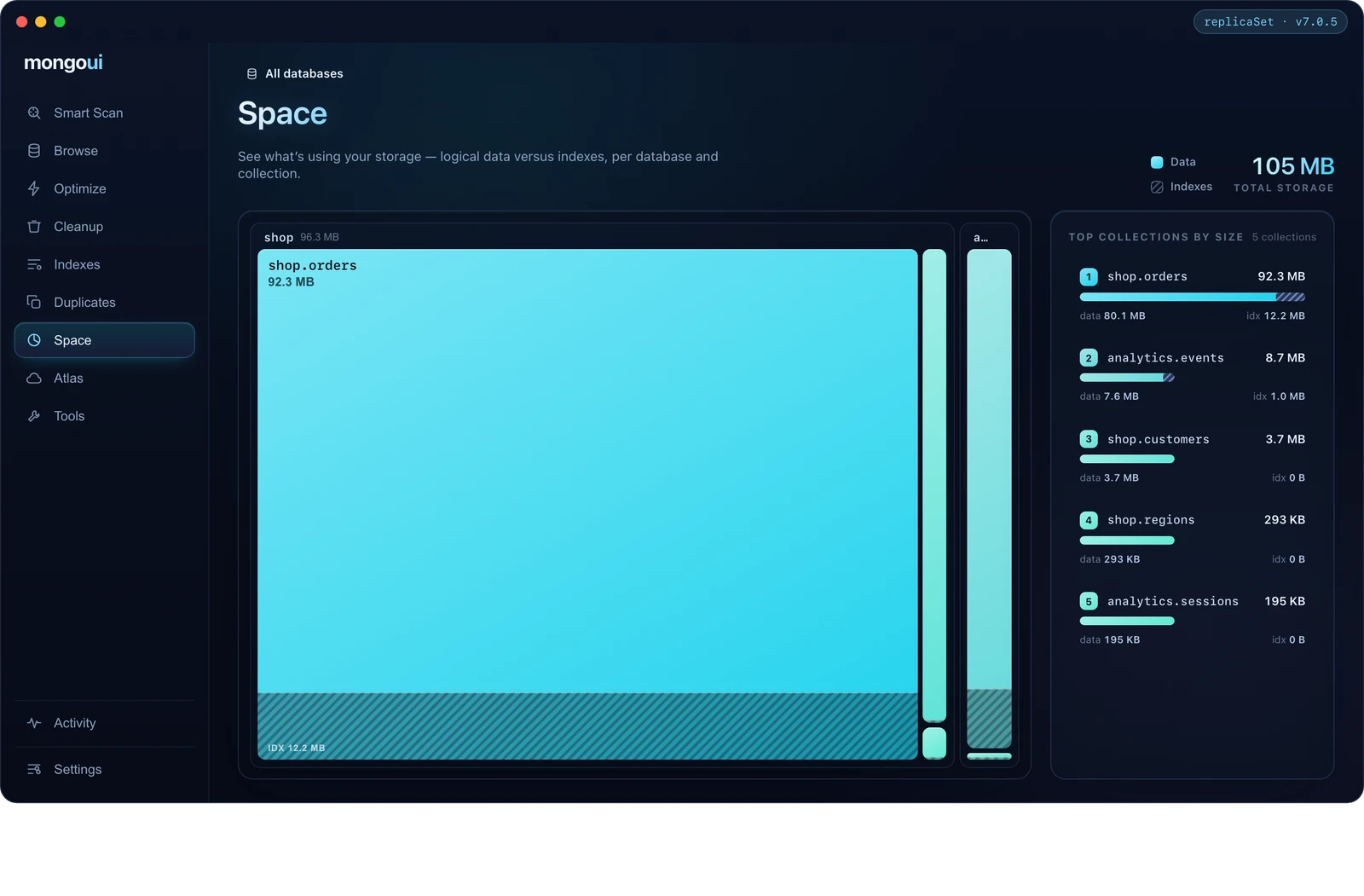
Smart Scan. One click runs a full health pass across indexes, storage, duplicates, and schema.
The story behind
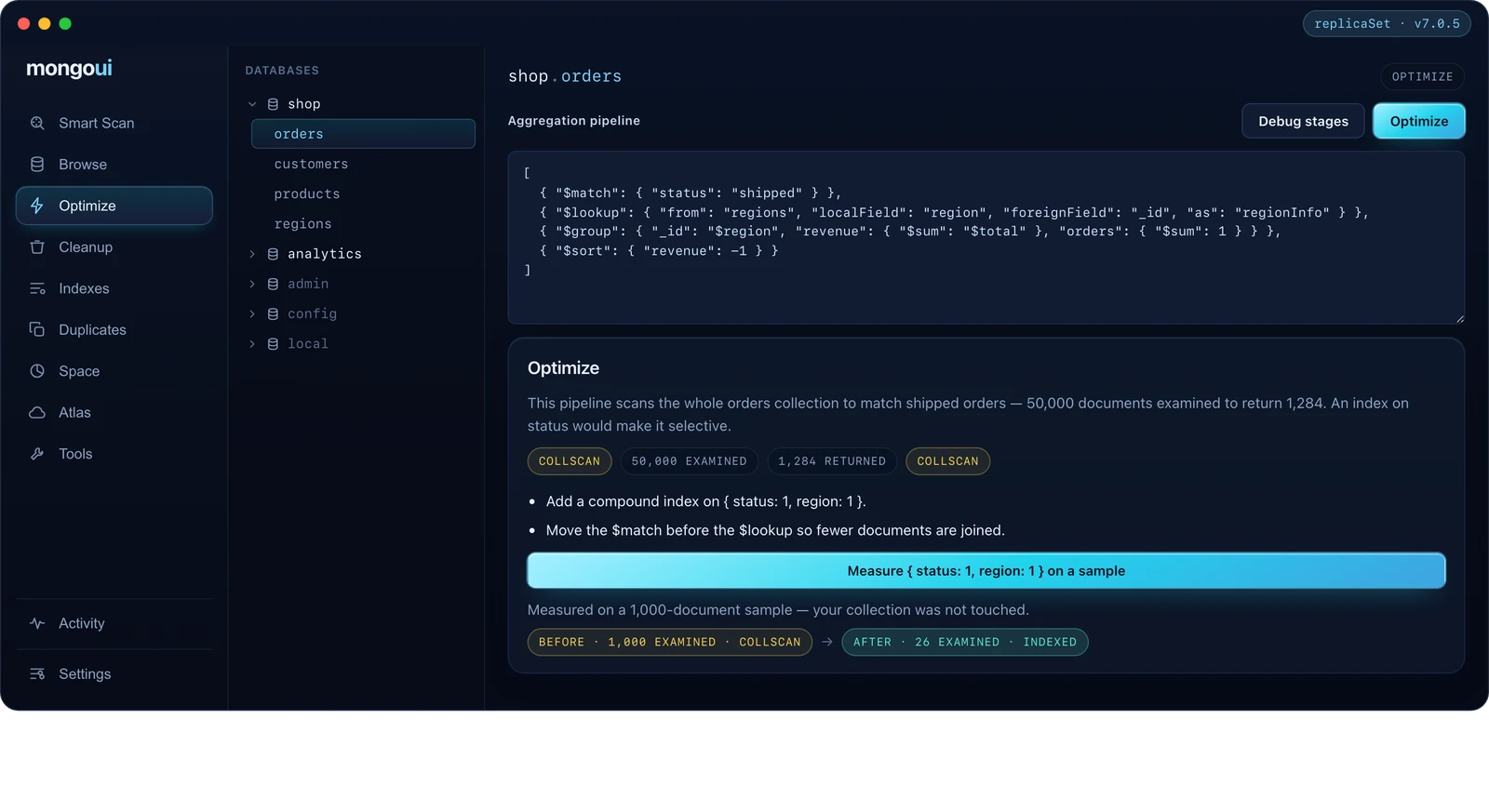
A MongoDB GUI is easy until the query is slow. Browsing documents is the simple part. The hard part is the aggregation that is slow for a reason the tool will not tell you. Compass shows what a query runs, not why. mongoui reads your real explain() output back in plain English: the COLLSCAN, the documents examined versus returned, and the specific index that fixes it. For an aggregation, where a pipeline cannot be paused server-side, it replays each progressively longer prefix, ends each one in a count so only a number comes back, and reports the real per-stage document deltas in the order you wrote them. It also flags when the planner reordered your stages, so explain() stops being a surprise.
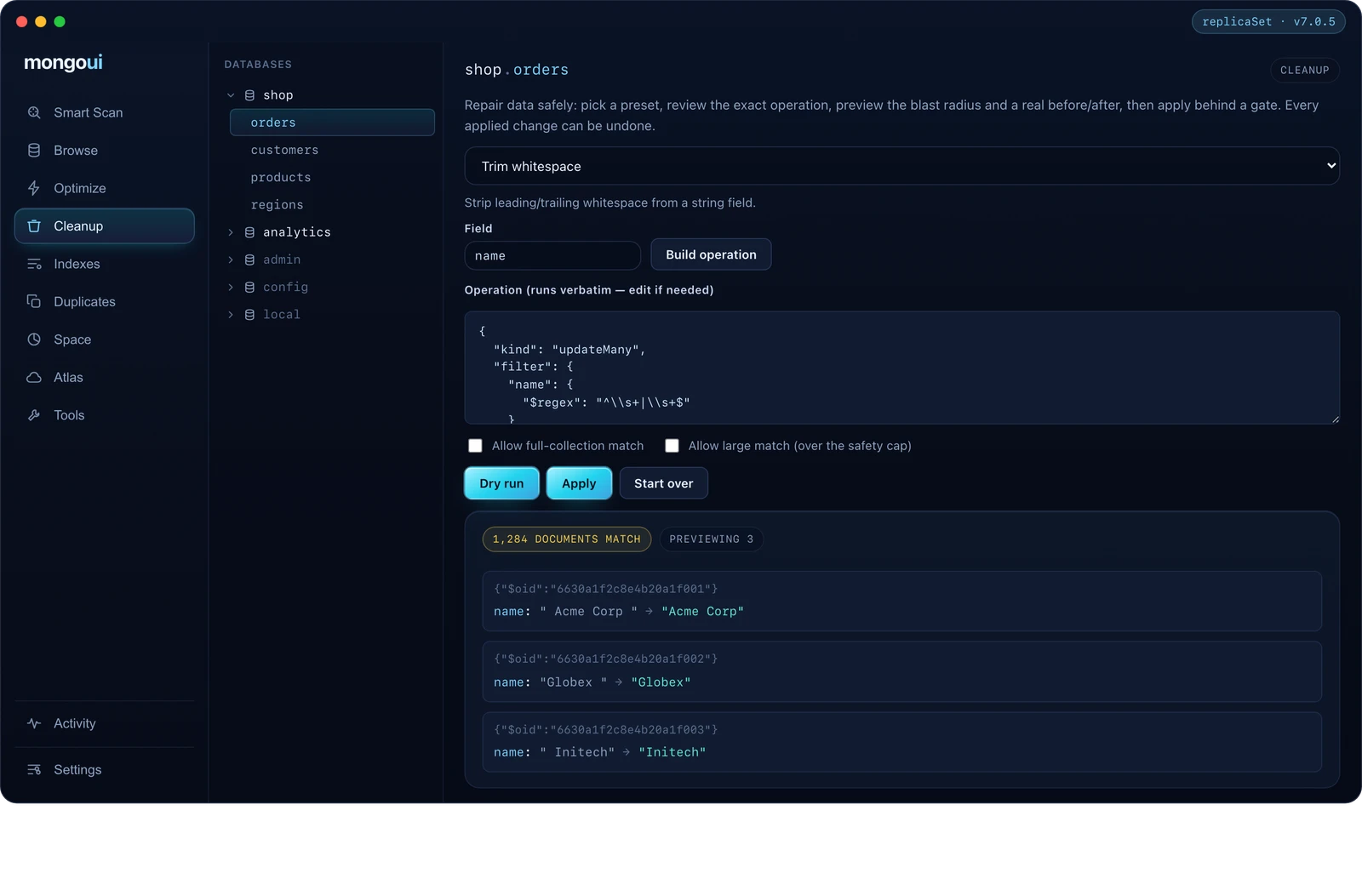
The load-bearing decision was where the connection runs. Production and self-hosted databases sit on private networks a cloud app cannot reach, and holding someone's connection string server-side is the wrong posture for a tool you trust with prod. So the engine runs on your machine and connects directly. The only thing any AI path may send is a redacted context: schema, field names, index definitions, explain() output, and pipeline text. Raw values are off by default, and on means type-masked, never the real row. The optimizer holds the same honesty line: a proposed index is labelled estimated until it is measured on a throwaway sample, because MongoDB has no hypothetical-index feature and a guessed number is worse than none. And because Mongo has no undo, every cleanup snapshots the matched set before it writes, so a wrong update is one click to reverse.
Business value
- One click runs a full health pass over indexes, storage, duplicates, and schema, so problems surface before they bite.
- Production and self-hosted databases work, because the connection never leaves your machine.
- The AI answers from your real schema and explain() output, so it stops inventing syntax that looks right.
- A proposed index is measured on a sample before you trust it, not guessed.
- A bad-data cleanup carries a pre-write snapshot, so a wrong update is one click to undo.
Project scope
- A local engine with connection and topology detection, schema inference, and paged document browsing.
- A one-click Smart Scan health pass across indexes, storage, duplicates, and schema.
- An explain() parser and optimizer that proposes an index and measures it on a non-destructive sample.
- A prefix-replay pipeline debugger with real per-stage counts and planner-reorder detection.
- A safe-cleanup write path with a dry-run diff, a blast-radius count, and a snapshot rollback before any write.
- A redaction boundary that assembles the only payload any AI path is allowed to send.
Deliverables
- A signed and notarized desktop app for macOS and Windows, with Smart Scan, Browse, Optimize, Cleanup, Indexes, Duplicates, Space, and Schema doctor.
- A typed IPC bridge, so the UI never touches the driver or credentials.
- Claude Opus 4.8 narration that cites the real plan, the COLLSCAN, and the per-stage counts.
- A headless CI gate that fails a pull request when a pipeline regresses, on documents examined, not wall-clock.
Tech stack
Frequently asked
Is mongoui another admin panel?
No. It is a local-first desktop GUI focused on the hard part: reading your real explain() output, measuring the index that fixes a slow query, and cleaning bad data with a rollback. The connection runs on your machine, so production and self-hosted databases work.
Does my data get sent to the AI?
Not by default. The only thing any AI path may send is a redacted context: your schema, field names, index definitions, explain() output, and pipeline text. Raw sample values are off by default, and on means type-masked, never the real row. Bring your own key and the call goes straight from your machine.
How is it different from MongoDB Compass?
Compass shows what a query runs. mongoui works on why it is slow and how to fix it: an index measured on a sample before you trust it, per-stage document counts from a real pipeline replay, and AI grounded in your actual plan instead of generic syntax that looks right.
Can you build something like this for us?
Yes. The local-first architecture, the on-device redaction boundary, and the measure-before-you-trust pattern are things we can put on your own product or infrastructure.
Have a workflow that needs this?
Tell us the shape of the problem. Scoped estimate, usually within 1-2 business days. No card, no obligation.
Estimate this buildor email business@highcraft.ioMore work
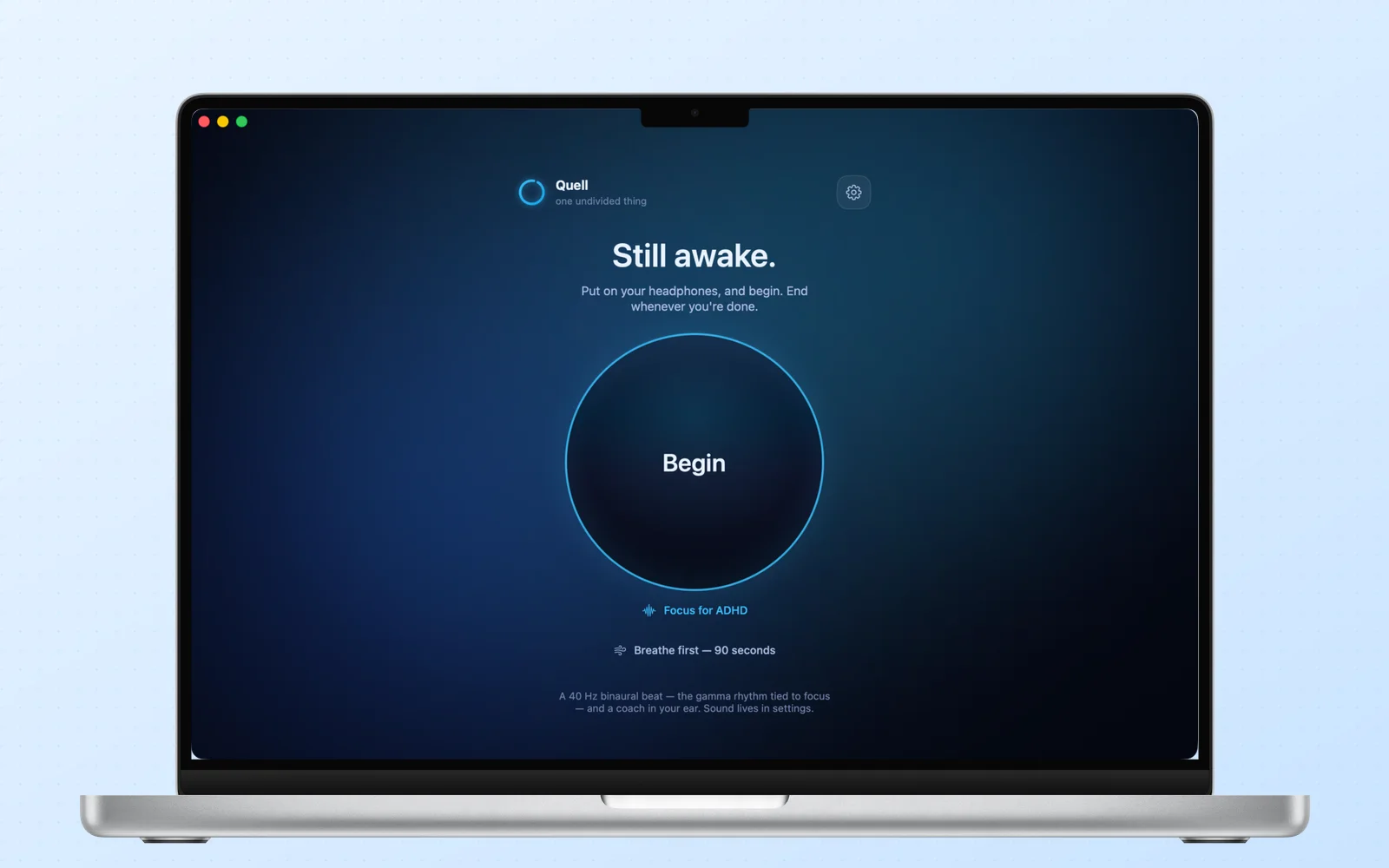
Quell focus app
A focus app that generates a 40 Hz binaural beat, a neural-voice coach, and AI music on the device. No accounts, no server, works offline.
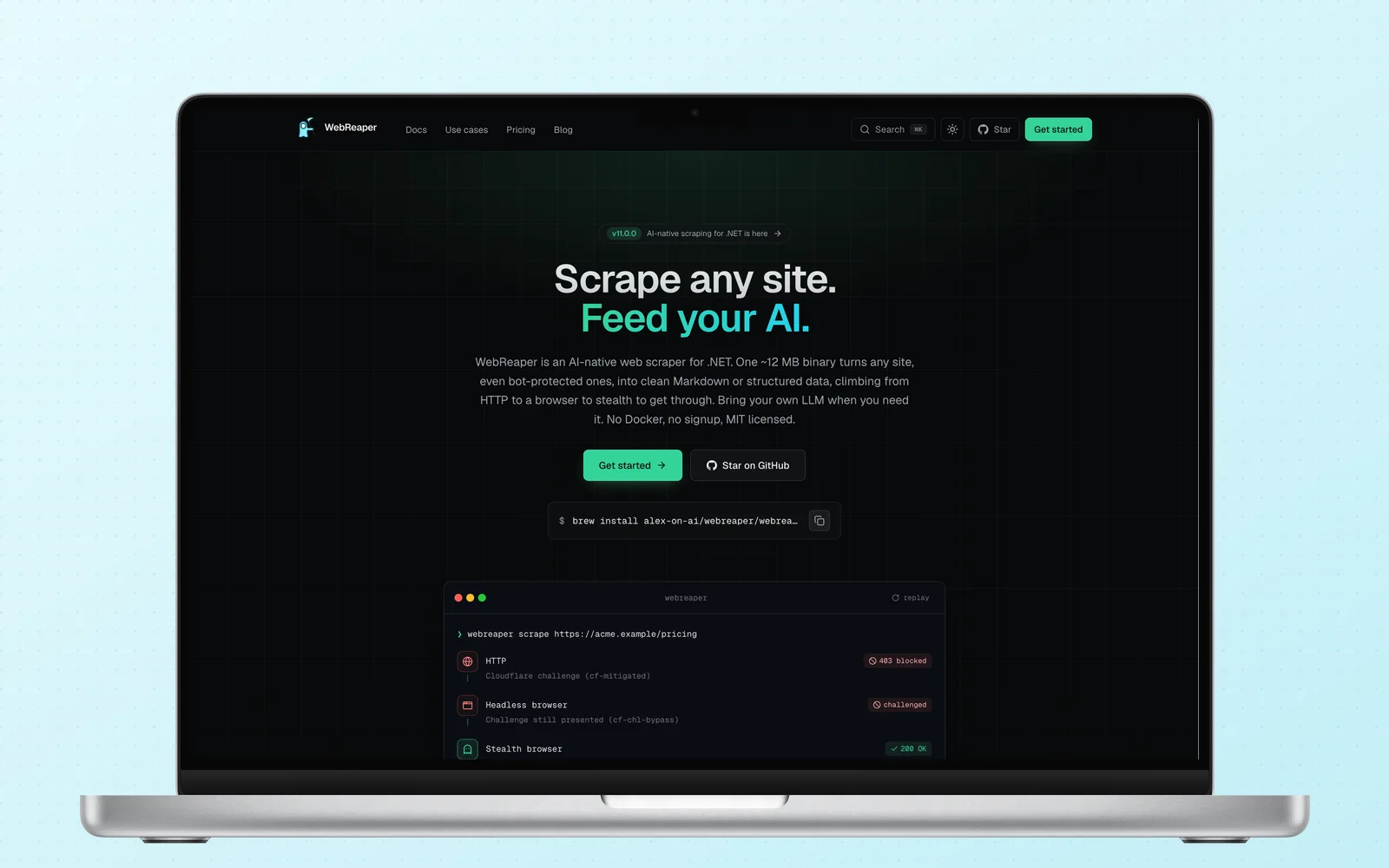
WebReaper
One small binary turns any site, bot-checks included, into clean Markdown or structured data for your LLM. MIT licensed, bring your own model.
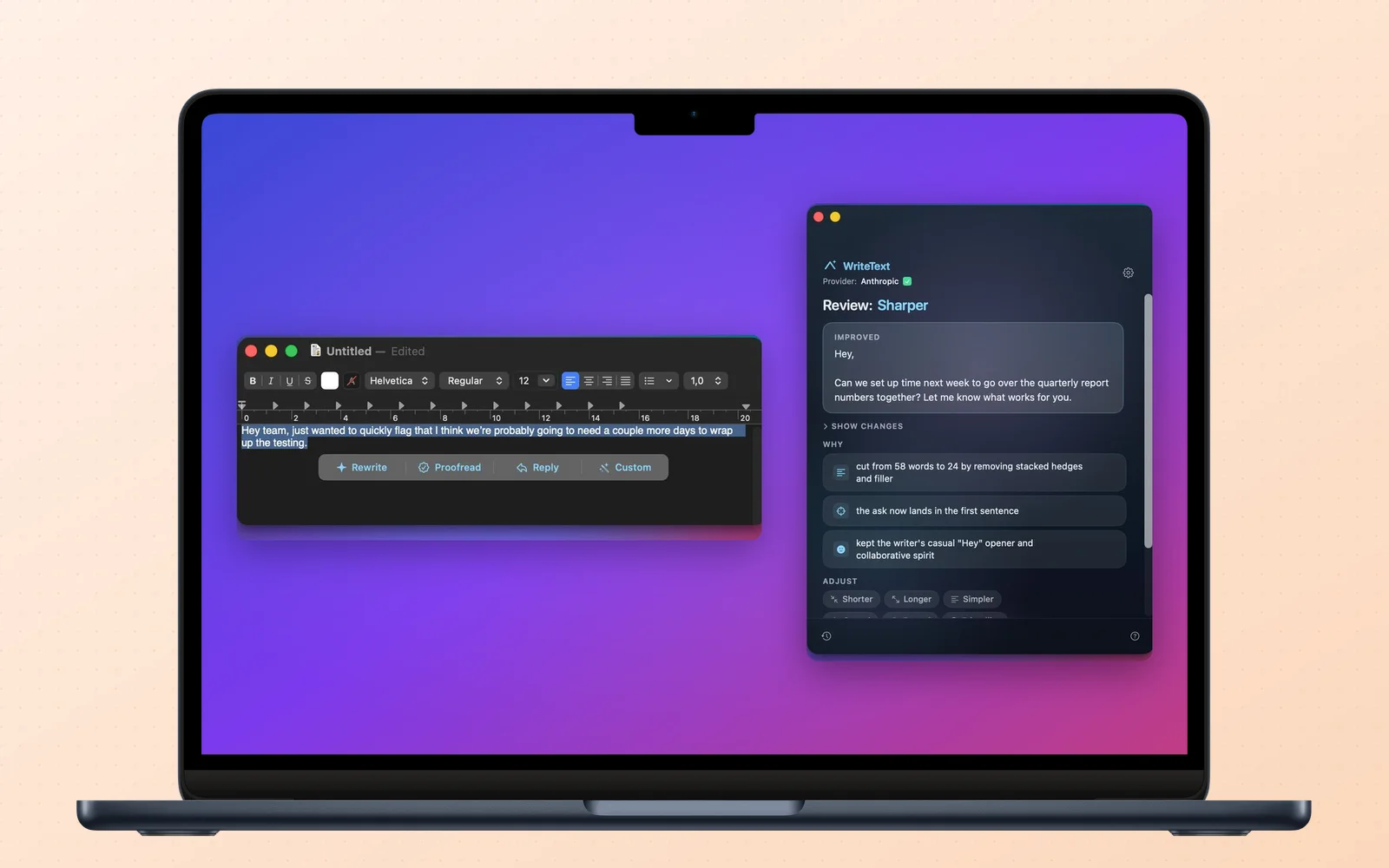
WriteText
WriteText is a menu-bar Mac app that rewrites a selection where it already sits, in Mail, Slack, or anything else, through the LLM provider you bring.