Every founder who types "product development company" into Google is really asking one question: who is going to own this thing when it breaks on a Tuesday. Not who can draw the roadmap. Not who has the nicest case-study page. Who answers the phone when the payment webhook fires twice and a patient record ends up in two places. (I have been on that call. It is not a call you want to make to a marketplace profile.)
So this page is not a pitch. It is a comparison of the five ways serious products actually get built, what each one is good at, and the rule I would use to pick between them if I were spending my own money. We run the fifth option, which I will disclose up front, and then try to be useful anyway.
The short answer
Hire a product development company when the scope is real but not frozen, the system touches more than two external services, and you need one party accountable for architecture, delivery, and the on-call pager at the same time.
Hire in-house when the product is your core intellectual property and you can keep three or more engineers busy for eighteen months. Hire staff augmentation when you already have a technical leader who knows exactly what to build and just needs more hands on keyboards. Hire a freelancer when the work is one bounded, well-specified piece. Use no-code when the workflow still changes weekly and nobody has agreed what the data model is.
Four of those are good answers. Picking the wrong one costs you a quarter, not a week.
What a product development company actually owns
The term gets used loosely, so here is the version that matters contractually. A product development company owns the outcome, not the hours. That means it owns the architecture decisions, the delivery schedule, the code review gate, the release approval, and the audit trail behind all four.
In practice, the things our team signs its name to look like this. Data model and service boundaries. Authentication and authorization, including role scoping for clinical versus administrative users. Integration contracts with every external system, including the retry and idempotency behavior when the external system has a bad morning. Deployment pipeline and environment separation. Logging, alerting, and what happens between the alert and the fix. Documentation that lets a new engineer ship on day three instead of week three.
An agency that only owns "the build" hands you a repository and a handshake. The difference shows up about four months later, when someone needs to add a second insurance payer and discovers the first one was hard-coded in six places.
One more distinction worth making. A product development company gives you a technical counterparty, which means there is somebody whose job is to disagree with you. If every requirement you send comes back as "sounds great, we'll do it," you did not hire engineering. You hired agreement, and agreement is cheap.
Five ways to get a product built, side by side
| Option | Who owns architecture | Ramp to first release | Holds up well when | Breaks when | Who is accountable at 2am |
|---|---|---|---|---|---|
| In-house team | Your engineering lead, once hired | Longest. Hiring, onboarding, then build | The product is core IP and the roadmap runs for years | You need five skill sets and can only afford two salaries | Your team, which is also your only team |
| Product development company | The vendor, with your sign-off on decisions | Short. The team is already assembled and senior | Scope is real, integrations are many, deadline is fixed | You want to change direction weekly without re-scoping | The vendor, under the contract |
| Staff augmentation | You. The contractors execute your design | Short for hands, slow for context | You have a strong CTO and a clear backlog | Nobody internal owns the architecture, so each contractor invents their own | You, because the contractors bill by time |
| Independent freelancers | Split across whoever is available | Shortest for one bounded task | The job is a single module with a written spec | The work spans auth, data, integrations and deploys | Nobody, unless you retained them for support |
| No-code or low-code assembly | The platform vendor | Days for a workflow, not a product | Workflows change weekly and the data model is unsettled | You hit per-record limits, audit requirements, or a custom integration | The platform's support queue |
Comparison based on how each engagement model is structured contractually and operationally, not on vendor marketing claims. Your mileage varies with the specific people in each box.
The table hides one thing worth saying out loud. These models are not mutually exclusive and the best setups mix them. A common and sensible shape is one in-house product owner, a product development company carrying delivery, and a no-code layer handling internal ops that nobody wants to maintain code for. That is not indecision. That is putting each tool where it is cheap.
A decision framework that takes about four minutes
Three tests. Answer them honestly and the model picks itself.
Start with the scope-freeze test
Can you write the acceptance criteria for the first release today, in a form a stranger could test against? Not the vision. The criteria.
If yes, a fixed-scope engagement is the cleanest option, and you should expect a fixed number back. If no, do not sign a fixed-scope contract, because you will spend the engagement arguing about what was included and the vendor will spend it protecting margin. Run a short paid discovery or a prototype sprint first, get to frozen criteria, then buy the build. A technical advisory engagement exists exactly for the "we know the problem, we have not yet chosen the shape" stage.
The anti-pattern here is buying a six-month build off a two-page brief because the brief felt confident. Confidence is not specification.
Then count the integrations
Count the external systems the product must talk to. Payments, identity, an EHR, a claims clearinghouse, a scheduling system, a document store, an analytics sink. Each one is a contract with its own authentication model, rate limits, pagination quirks, sandbox that behaves differently from production, and support team with a four-day SLA.
Here is the rule I use. Zero or one integration, a freelancer or a small augmented team can carry it. Two, it depends on your internal technical leadership. Three or more, you want one party owning the whole integration surface, because the failures are rarely inside a single integration. They happen in the seams, and the seams belong to nobody unless you assign them.
A concrete example of a seam. Stripe retries webhooks. Most EHR APIs do not support a true transaction across resources. So if a paid appointment triggers a record write and the write fails halfway, you need an idempotency key, a dead-letter path, and a reconciliation job that somebody reads. None of that is in any spec document anybody sends us. All of it ends up in the invoice if it was not planned.
Then check who is on the hook at 2am
Ask every candidate the same question: who signs the release, and what happens if the release is bad.
If the answer is a coordinator who has never read a migration script, you bought project management, not engineering. If the answer involves a named senior engineer and a rollback plan, you bought the thing you came for. Our releases go through code review and an approval gate before they touch production, and the trail of who approved what is kept, which matters less on day one and a great deal on the day an auditor asks.
Accountability is the quietest line item and the most expensive one to skip. Everything else on this page is negotiable.
Where the money actually goes
Three cost shapes, and they fail differently.
Time and materials bills hours. It is honest and it is flexible, and it transfers all schedule risk to you. It works when your internal leadership is strong enough to steer weekly.
Fixed scope bills an outcome. Risk sits with the vendor, which is why the number includes a buffer, and why the scope document gets read carefully by both sides. It works when the scope-freeze test passed.
Retained capacity buys a reserved senior team per month. It works when the roadmap is continuous and the thing you are actually buying is availability.
What nobody prices on a website is the cost of rework. The expensive line in a product budget is almost never the feature that was built. It is the feature that was built on an assumption that turned out to be wrong, discovered in month five, touching nine files. That is why we push discovery and why a two-week prototype in front of a six-month build is usually the cheapest money in the project. If you want a number against your actual scope rather than a range against a stranger's, estimate your project and we will come back with the shape and the assumptions behind it.
Honestly, the other cost people miss is their own time. Staff augmentation looks cheaper per hour until you count the twelve hours a week your technical lead spends unblocking contractors. That is a real salary line, it just lives in a different column.
Regulated work changes the comparison
If your product touches protected health information, the comparison table above loses a row in practice. No-code assembly rarely survives first contact with an audit, and freelancers typically cannot sign a Business Associate Agreement that means anything, because a BAA with no organization behind it is a sentence, not a control.
Two anchors worth knowing before any vendor conversation.
The HIPAA Security Rule requires a risk analysis as an explicit implementation specification, under 45 CFR 164.308(a)(1)(ii)(A). It is not optional guidance. The U.S. Department of Health and Human Services keeps the rule and its guidance material published at hhs.gov. NIST published SP 800-66 Revision 2 in February 2024 as the implementation guide for that rule, and it is the document a serious engineering partner will actually have read, not just cited. It lives at csrc.nist.gov.
Second anchor. The HHS Office for Civil Rights publishes every reported breach affecting 500 or more individuals on a public portal. That threshold comes straight from the Breach Notification Rule. Design accordingly, because "we will add audit logging later" is a plan that ends on a public web page with your company name on it.
On the interoperability side, the practical question is whether your partner has built against HL7 FHIR resources and knows which ones your target system actually implements, because coverage varies by vendor and by version. The specification is public at hl7.org/fhir. If a prospective partner describes FHIR as "just a REST API," thank them and continue your search.
When the regulatory layer is in play, the engagement model that works is the one where a single company carries the BAA, the access controls, the review gate, and the evidence. That is a structural answer, not a marketing one.
Fifteen things to check before you sign
- Who specifically signs off on releases, by role and name
- Whether code review is a gate or a suggestion
- Repository ownership from day one, in your organization
- Environment separation, including whether anybody tests against production data
- Access model: who holds credentials, and whether that list is reviewed
- BAA availability, if PHI is in scope, signed by an entity and not a person
- Which FHIR or HL7 v2 interfaces they have shipped against, and in which direction
- Audit logging design, including retention and who can read the logs
- Incident response: the path from alert to fix, with a named owner
- Rollback plan and how long a bad release stays live
- Handover artifacts: architecture notes, runbook, onboarding path for a new engineer
- Whether the people in the sales call are the people on the project
- Change-request process and what triggers a re-estimate
- Dependency and licensing policy for third-party packages
- What happens at the end of the contract, in writing
Checklist derived from the delivery controls a buyer can verify during procurement. Print it. Ask all fifteen. Watch which questions cause a pause, because the pauses are the data.
Signals you picked the wrong model
Velocity that looks fine in the standup and terrible in the repository. Three contractors who each built their own helper for the same thing. A staging environment that nobody trusts, so testing happens in production with a brave face. Estimates that only ever grow by exactly the amount of the last overrun. A product owner who spends more time translating between contractors than talking to users.
And the classic: a feature that works for one customer and requires a code change for the second. That is not a feature. That is a configuration problem wearing a feature costume, and it compounds quietly until somebody asks why onboarding a client takes nine days.
None of these mean the people are bad. They usually mean the model is wrong for the stage. Switching models mid-flight is painful, which is the entire reason this page exists.
How we run delivery
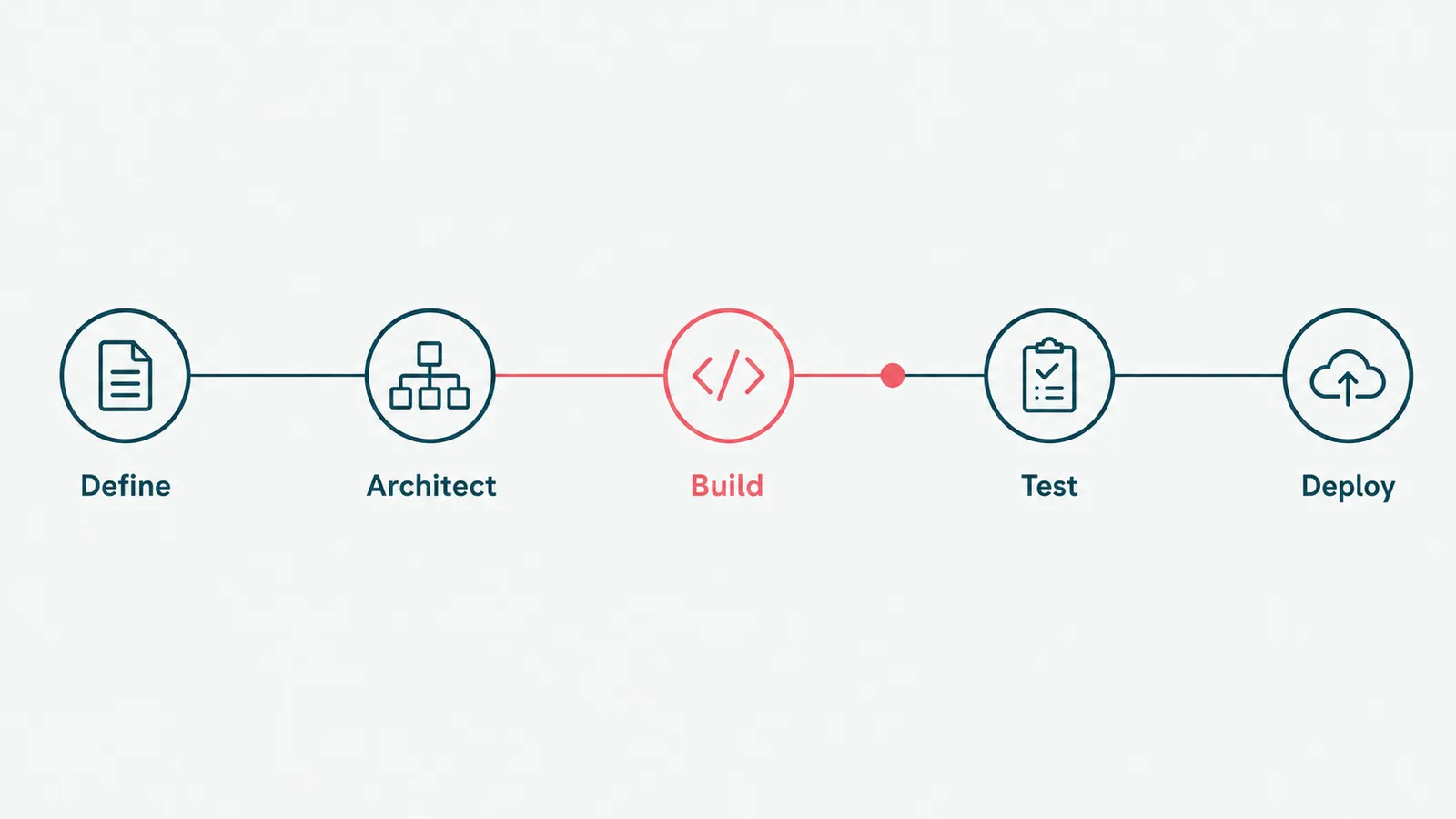
We are a product development company for healthcare, SaaS, and expert-led operators whose real work has outgrown the tools it started in. The stack we build on is .NET and Azure, with React on the front and Stripe where money moves. Our team runs discovery before scope, code review before merge, and approval before release, and we keep the trail.
Eleven years of building software sits behind the architecture decisions, including leading a FinTech engineering team at a Big Four firm. The public credential is Top Rated with a 100 percent Job Success Score on Upwork, earned one delivery at a time. We hold access, not assets, and your repository is yours from the first commit.
Where we tend to do the most good is the messy middle: a US digital-health platform that needs clinical workflows, an EHR integration, and a payment path to behave like one system instead of three that were introduced at a party.
If the direction is still open, start with a short advisory or prototype engagement and buy the build after. If the scope is already frozen, you do not need discovery and we will say so.
Related work
- HIPAA-compliant software development, for the controls and evidence side of regulated builds.
- Healthcare API integration, for FHIR, HL7 v2, and the seams between systems.
- Custom healthcare software development, for clinical and operational workflows built to fit.
Pick the model that matches your stage, not the one that matches your budget spreadsheet. The spreadsheet always loses that argument, usually in month five, right around the time somebody asks who owns the integration.