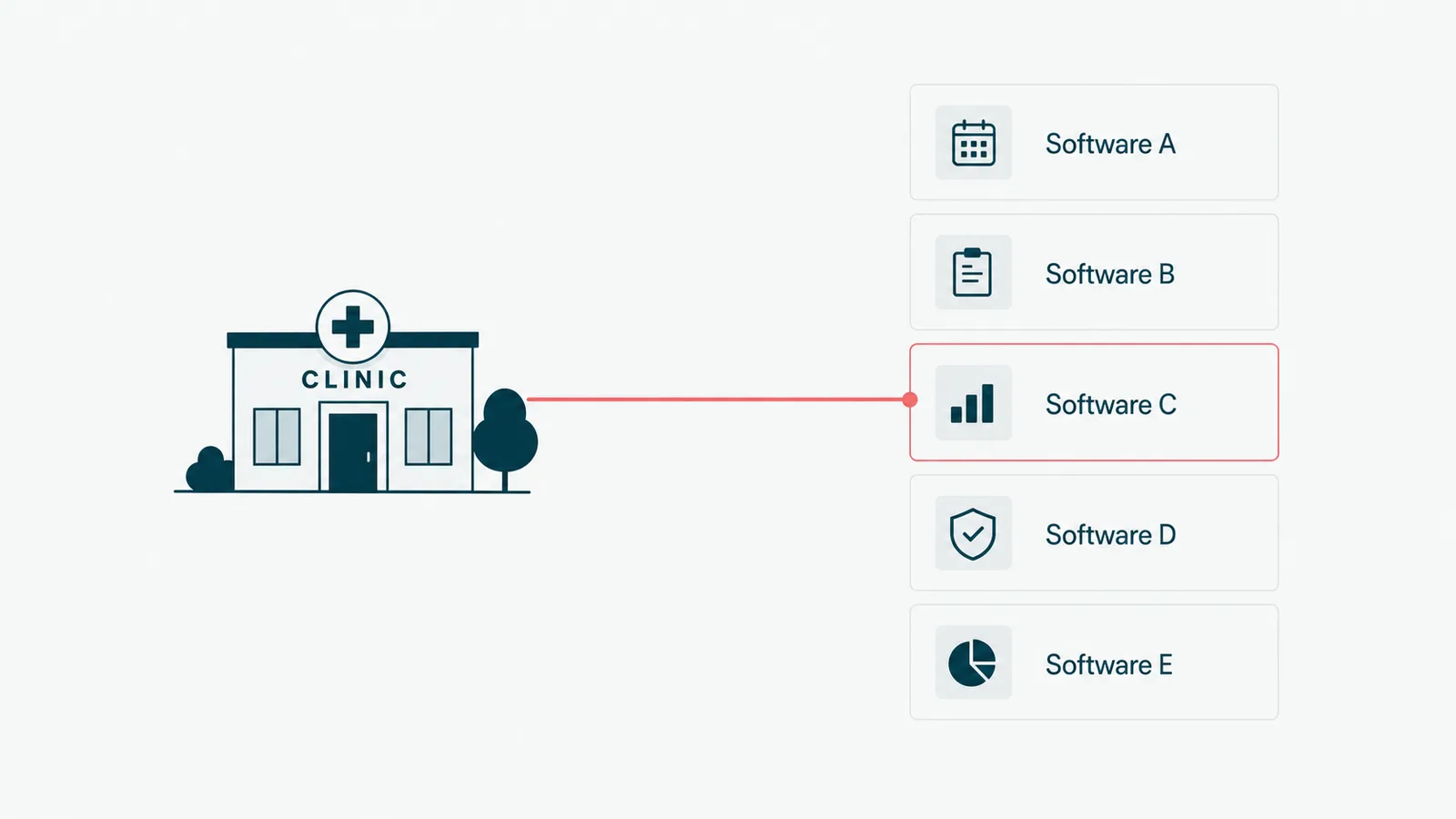
Ask ten family physicians which EMR is best and you get eleven answers, two of which are "the one we had before this one." That is not indecision. Family practice runs newborn checks, diabetes panels, Medicare annual wellness visits, and a same-day sore throat before lunch. No single product is the top pick for every version of that day.
So this page does not crown a winner. It compares the real options a family practice chooses between, names what each one is good at, names where each one strains, and gives you a decision rule you can apply in a demo instead of in a regret retrospective.
We build and integrate clinical software for a living, which means we see EMRs from the inside: the API docs, the HL7 feeds, the export that was promised and the export that arrived. That is the angle here.
The short answer: pick on visit mix, billing model, and data access
Three variables decide this, and the feature grid is not one of them.
Visit mix. Count your top five visit types from last quarter. Chronic care management, well-child, Medicare AWV, acute same-day, and procedures look very different in a chart. The EMR that templates your top five in two clicks beats the one with four hundred templates you will never open.
Billing model. Fee-for-service with a biller on staff, full outsourced revenue cycle, direct primary care with memberships, or value-based contracts with quality reporting. These pull toward different products. A membership practice does not need a claims engine tuned for payer mix. A practice with two MIPS-reporting clinicians absolutely needs certified quality measure support.
Data access. Whoever controls the read path controls your options later. Ask for a FHIR sandbox token during evaluation, not after signature. If the answer involves legal review before you can read your own appointment list, you have learned something useful about the next five years.
Decision rule we use with clients: if a vendor cannot show you your own data leaving their system in a documented, standards-based format, treat every other promise as conditional.
Family-practice EMR options, compared
| Option | Typical fit | Strong where | Strains where | Data access posture | Engineering work it creates |
|---|---|---|---|---|---|
| All-in-one cloud ambulatory EMR with bundled billing and RCM (for example athenahealth, eClinicalWorks, NextGen Office) | 2 to 25 providers, fee-for-service, payer-heavy | Claims, clearinghouse, scheduling and charting in one contract and one support line | Workflow is the vendor's workflow, configuration has a ceiling | Vendor-published APIs plus certified FHIR endpoints, access terms vary by contract | Low to start, rises when you add outside tools |
| Primary-care-focused cloud EMR (for example Elation Health, Practice Fusion) | 1 to 10 providers, longitudinal primary care, DPC and small groups | Charting speed on routine primary-care visits, fast onboarding | Complex multi-specialty billing, heavy custom reporting | Certified FHIR endpoints, partner integration programs | Low, mostly integration glue |
| Enterprise EMR extended by an affiliated health system (for example Epic Community Connect, Oracle Health) | Practices inside an IPA, ACO, or hospital affiliation | Shared chart with specialists and the hospital, referral continuity | Independence, governance speed, change requests queued behind the host | Governed by the host organization, not by you | Medium, and every change goes through the host's process |
| Open-source or self-hosted EMR (for example OpenEMR) | Practices with in-house or contracted engineering, unusual workflows, cost-sensitive growth | Total configurability, direct database access, no per-seat lock-in | Hosting, patching, backup, certification verification, support all land on you | Full, you own the schema | High and ongoing, this is an operational commitment |
| API-first EMR platform with public developer documentation (for example Canvas Medical, DrChrono) | Groups building a differentiated patient experience or automation layer | Programmatic workflows, custom front ends, embedded tooling | Out-of-the-box coverage for every back-office task | Documented public APIs as a product feature | Medium to high by design, that is the point |
| Keep your EMR of record, build the layer around it | Practices where charting is fine and everything around charting is manual | Intake, portal, referral tracking, reporting, automation, without a rip-and-replace | Nothing fixes an EMR your clinicians genuinely hate | Limited by what your EMR exposes | Scoped project, then maintenance |
Comparison basis: deployment and data-access models as published by each vendor category, plus certification status you can verify yourself on the ONC Certified Health IT Product List. Capabilities and contract terms differ by product edition and must be confirmed with the vendor.
Which option fits which practice
Four clean cases, and one that is usually a trap.
If you are an independent practice of two to twenty providers with normal commercial and Medicare payer mix, and nobody on staff wants to own infrastructure, the all-in-one cloud EMR with bundled revenue cycle is the default. You are buying one throat to choke on claims. That has real value on a Friday afternoon when a payer rejects a batch.
If you are one to eight clinicians doing longitudinal primary care, especially direct primary care or concierge, a primary-care-focused cloud EMR usually wins on charting speed. The product is narrower. Narrow is a feature when your day is twenty-two patients deep.
If you are inside a hospital affiliation, an IPA, or an ACO, the enterprise EMR extended by the host is often the right call even when it is not the product you would pick alone. Shared chart with the specialists you refer to is worth more than configuration freedom. Go in knowing your change requests sit in someone else's queue.
If your workflow is genuinely unusual, say a hybrid of membership primary care, occupational health, and a cash-pay service line, an API-first platform or an open-source core plus engineering gives you a system that matches the business instead of a business that matches the system.
The trap: switching EMRs because of documentation burden alone. Documentation burden is often an artifact of templates, order sets, and staff workflow rather than the product. Before you sign a new contract, have someone count clicks and seconds on your five most common visit types in your current system, then in two demos, on identical scripted patients. We have seen that single exercise cancel a replacement project. Migration is expensive. A template rebuild is not.
Certification is the floor, not the differentiator
Nearly every serious ambulatory EMR carries ONC certification, so certification does not separate candidates. What separates them is which certification criteria they hold and how they behave under the ones that matter to you.
Three things worth checking before the second demo.
The product's listing on CHPL, including certified criteria, any corrective action history, and the real-world testing plan. This is public. It takes ten minutes. Sales decks do not mention corrective action, and CHPL does.
Standardized API support under the 2015 Edition Cures Update criterion §170.315(g)(10), which requires FHIR Release 4 access against the US Core implementation guide for single-patient reads and population-level access using the FHIR Bulk Data Access specification. That distinction matters more than it sounds. Single-patient read gets you a patient app. Bulk export gets you registry reporting, quality measures, and a migration path. Ask which one is enabled on your edition, and ask what the vendor charges for it.
Information blocking posture under the 21st Century Cures Act Final Rule (2020). The rule constrains practices and certified health IT developers both. A vendor that treats your export request as a commercial negotiation is telling you how renewal will go.
For context on adoption, ONC's Health IT Quick-Stats report 78% of office-based physicians had adopted a certified EHR as of 2021. Translation: you are not choosing whether to run certified health IT. You are choosing which certified system you will be arguing with for the next seven years.
And on the security side, the HIPAA Security Rule requires a documented risk analysis, which covers your configuration and your third-party integrations, not just the vendor's data center. See the HHS Security Rule guidance. If you are adding anything custom around the EMR, that assessment is part of the work, and we treat it that way in HIPAA-compliant software development.
The 12-point shortlist checklist
Run this against every finalist. Score it in writing, because memory is generous to whichever demo was last.
- Click and second counts for your top five visit types, scripted identically across vendors
- Certified criteria confirmed on CHPL, including §170.315(g)(10), for the exact edition you are buying
- A working FHIR sandbox token issued during evaluation, not promised for later
- Bulk export tested once with real volume, not a three-patient sample
- Written answer on what data you receive at termination, in what format, and at what cost
- e-prescribing including EPCS, with the enrollment timeline in writing
- Lab interfaces for the labs you actually use, named, with interface build cost and lead time
- Immunization registry submission for your state
- Quality reporting your contracts require, with measure specs confirmed, not "supported"
- Patient portal behavior on the three things patients call about: refills, results, balances
- Uptime and support terms in the contract, plus the escalation path for a billing outage
- Total cost across year one and year three, including interface fees, clearinghouse fees, and implementation
Basis: ONC Health IT Certification Program criteria, the HIPAA Security Rule risk-analysis requirement, and the integration surfaces family practices depend on daily. Adapt the quality-reporting line to your payer contracts.
Twelve items looks like a lot until you price the alternative. A bad EMR decision is a seven-year decision with a two-week sales cycle.
Buy the EMR. Build the layer that makes it fit.
Here is the part most comparison pages skip, because it does not fit a vendor grid.
You should almost never build an EMR of record from scratch for a family practice. Certification, e-prescribing, claims, registry submissions, and ongoing regulatory maintenance are a product company's full-time job. Buy that.
What practices actually build is the layer around it. Intake that does not hand a tablet to a 78-year-old with the same twelve questions a receptionist already asked. Referral tracking that closes the loop instead of living in a spreadsheet with fourteen tabs, which is your process telling you it had ambitions the tool could not support. Prior authorization status that someone can see without three phone calls. Reporting that answers "how many uncontrolled A1c patients have not been seen in nine months" in one query rather than one afternoon.
Our decision rule for build versus buy in ambulatory primary care:
Buy when the workflow is regulated, standardized, and shared by every practice in the country. Claims, prescriptions, charting, certified measures.
Build when the workflow is how you differentiate or where your staff loses hours. Intake, triage, recall campaigns, membership billing, patient communication, internal dashboards, anything currently held together by one person who knows the trick.
Then connect the two properly. That is healthcare API integration work: FHIR R4 where it exists, HL7 v2 where it still rules, SFTP and flat files where a lab interface was built when jQuery felt like the future. We also build the surfaces patients touch, which is usually patient portal software development, and the clinical data models underneath when a group needs more than the EMR exposes, which is EHR software development.
One engineering specific that saves money: cache nothing you can re-read, and persist everything you must reconcile. Teams that mirror the entire chart into a side database inherit two sources of truth and a permanent sync bug. Teams that read on demand and store only their own workflow state ship faster and sleep better. Scope that boundary on day one, not in month four.
Migration is where family practices lose six months
Three phases, and the middle one is the one that bites.
Extraction. Structured data moves reasonably well through FHIR bulk export or a vendor-supplied extract. Problem lists, medications, allergies, immunizations, demographics, insurance. Expect to clean duplicates. Expect code mapping work between vendor-local codes and standard vocabularies.
Documents and the parts that were never structured. Scanned PDFs, faxes, old notes, growth charts stuck in an image. This is where timelines slip. Decide early what moves into the new chart, what stays in a read-only archive, and who signs off on that distinction clinically. Write it down before the go-live date is announced to patients.
Parallel running and reconciliation. Billing cannot stop. Claims from the old system keep adjudicating for weeks while the new system starts producing. Plan a window where both run, with one named owner reconciling payments daily. This is boring, which is exactly why it gets skipped.
A practical rule: schedule go-live after your heaviest billing week, never before it. And cut your schedule by 25% for the two weeks after go-live. The practices that protect that buffer get through in a month. The ones that do not spend a quarter apologizing to patients at the front desk.
If you want the integration and migration path mapped before you commit, estimate your project and we will scope the data work against your actual EMR and payer setup.
Related work
- EHR software development for clinical data models, charting modules, and systems that have to survive an audit
- Healthcare API integration across FHIR R4, HL7 v2, and the lab interface that still runs on a file drop
- HIPAA-compliant software development with access control, audit trails, and documented release approvals
- Patient portal software development for refills, results, balances, and the three other things patients call the front desk about
Pick the EMR your clinicians can chart in without flinching, then build the layer that handles everything the vendor was never going to build for you. We will do the integration work, the migration reconciliation, and one terrible joke about your lab interface. The joke is free.