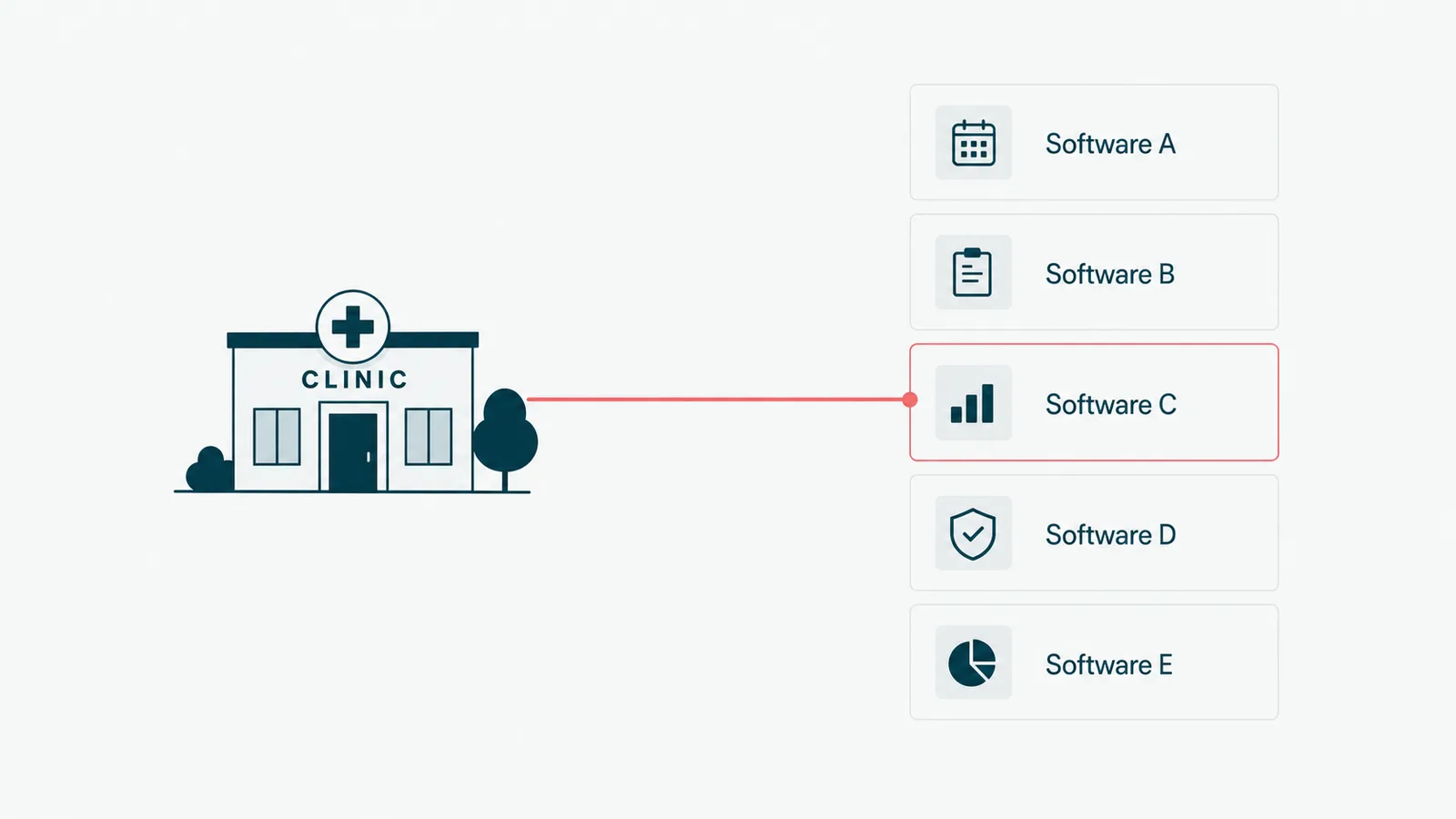
Most med spa software searches end the same way. Somebody buys the platform that gave the best demo. Eighteen months later the front desk is running a spreadsheet called FINAL_final_v3, the injectors chart in the notes field, and the marketing team exports a CSV every Monday to figure out who is due for a follow-up. The software did not fail. It just never matched the way the business actually treats patients.
We build clinical software for healthcare operators, so we get pulled into these decisions after the fact, usually at the migration stage. This page is the version of that conversation we have before anyone signs. It compares the five real options, gives a decision rule for each, and lists what to test during the trial instead of the demo.
The only thing in a med spa that should be frozen is the neuromodulator. Not your data.
Short answer: match the option to your revenue mix, not to your headcount
There is no single best EMR for a medical spa, and any page that names one product without asking what you bill for is guessing. The choice comes down to four inputs: whether you touch insurance at all, how many clinical documentation types you run, how many locations share a patient record, and how much of your margin depends on memberships and retail.
Cash-pay, one to three locations, one clinical protocol per service: buy an aesthetics platform and stop shopping. Multiple service lines with different charting rules, device data, or a proprietary treatment program you sell as the differentiator: the calendar is not the thing you should own, the workflow is.
The five options, compared
| Option | Aesthetic charting depth | Booking, POS, memberships | Data ownership and export | Integration surface | Typical time to live | Best fit |
|---|---|---|---|---|---|---|
| Aesthetics-specific all-in-one platform | Built around injectable and device treatments, photo capture, treatment consents | Included in the same product, one patient record behind both | Vendor-hosted. Export scope and format vary, confirm before signing | Vendor-published API where offered, plus native marketing and payment tie-ins | Weeks | Cash-pay med spas, one to a few locations, standard service menu |
| Plastic surgery or dermatology EMR | Clinical-first documentation, procedure and photo workflows, prescribing | Present in some products, usually secondary to the clinical chart | Vendor-hosted. Clinical data models are richer, migration is heavier | Often supports clinical interfaces and lab or pharmacy connections | Weeks to months | Physician-led practices where medical work funds the aesthetics arm |
| Spa or salon booking platform with a clinical add-on | Forms and notes layered on a retail booking core | Strongest of the five, built for retail, staff pay, and packages | Vendor-hosted. Clinical records may sit in an add-on module | Retail and payment integrations are the strength, clinical ones less so | Days to weeks | Wellness-led operators where retail and scheduling drive revenue |
| General ambulatory EHR | Broad and specialty-agnostic. Aesthetic workflows need configuration | Basic scheduling. Retail and membership economics usually live elsewhere | Vendor-hosted. Certified products carry defined export criteria | Standards-based interfaces, including FHIR in certified products | Months | Any operator billing insurance or reporting to a federal program |
| Custom EMR built on your workflow | Exactly the protocols you run, nothing you do not | Built or integrated to your economics, including tiered memberships | You hold the database, the schema, and the export path | Whatever you need, including device, payments, CRM, and FHIR endpoints | Months, phased | Multi-site groups and platforms where the protocol is the product |
Basis: category-level comparison of deployment approaches, not a feature audit of named products. Verify every capability against the vendor's own documentation and business associate agreement before you buy.
How to decide in about ten minutes
Start with the disqualifiers, because they remove options faster than feature lists do.
Do you bill insurance for anything? A dermatology arm, reconstructive work, a covered hyperhidrosis treatment. If yes, you need a general ambulatory EHR or a clinical EMR with a claims path, and certification matters. If no, certification criteria written for federal incentive programs are not your problem, and paying for them is paying for someone else's compliance burden.
Then count re-typing. Walk the front desk for one hour and count how many times a person moves data that already exists in another system. Under five times a day, buy something off the shelf and move on. Over fifty times a day across locations, you are paying an integration tax in salary instead of software, and it compounds every time you open a room.
Then count clinical documentation types. One protocol per service, delivered the same way in every room, fits an aesthetics platform. Three or more materially different documentation models, plus device output, plus a program you license or franchise, and configuration turns into workaround archaeology.
Last, ask what happens if the vendor raises prices 30 percent. If the honest answer is "we would pay it," you do not own your patient data in any practical sense. That is not a reason to build. It is a reason to test the export path during the trial, which almost nobody does.
What med spa charting needs that generic EHRs treat as an afterthought
Four things break more med spa implementations than anything in a feature grid.
Before and after photos are protected health information, and they behave like nothing else in the chart. Phone photos carry EXIF metadata, including GPS coordinates, and consumer photo sync is the fastest way to move a patient's face into an unmanaged cloud account. What you want is capture inside the app, storage in object storage with server-side encryption, short-lived signed URLs instead of public links, and an audit entry per view. If a vendor cannot tell you where the image bytes live and who has read them, that is your answer.
Consents need version pinning. A signed consent has to reference the exact form version that the patient saw, and that version has to be immutable afterward. Plenty of systems let an admin edit a published form. If that edit silently applies to records already signed, you have a documentation problem that only surfaces during a complaint or a claim, which is the worst possible time to learn about your data model.
Good faith exams and delegation need to be queryable, not just filed. The chart should link the treating provider, the delegating physician, the exam, and the treatment date in a way you can query. The test question we ask vendors: show me every unit of neuromodulator administered under this medical director last quarter, by provider, in one screen. Some products answer in seconds. Some answer with a support ticket.
Lot numbers and expiry belong on the treatment record. Injectables and devices carry traceability obligations, and a recall is not the moment to reconcile inventory against appointments in a spreadsheet. Inventory that lives only in the retail module, with no link to the clinical event, is a gap you will feel exactly once.
The compliance floor, with citations rather than adjectives
Every option above can be run compliantly, and every option can be run badly. HIPAA obligations follow the covered entity, which is you, not the software logo.
| Obligation | What it requires | Citation |
|---|---|---|
| Business associate agreement | A written agreement with any vendor creating, receiving, maintaining, or transmitting PHI on your behalf | 45 CFR 164.308(b), HHS |
| Breach notification to individuals | Notice without unreasonable delay and no later than 60 days from discovery | 45 CFR 164.404, HHS |
| Patient right of access | Records provided within 30 days, with one 30-day extension permitted | 45 CFR 164.524, HHS |
| Audit controls | Mechanisms to record and examine activity in systems containing ePHI | 45 CFR 164.312(b), HHS |
| Risk analysis | An accurate assessment of risks to confidentiality, integrity, and availability of ePHI | 45 CFR 164.308(a)(1)(ii)(A), HHS |
Source: HHS Office for Civil Rights, HIPAA Security Rule guidance. Deadlines are the regulatory maximums, not a target.
Two references worth keeping open while you evaluate. NIST Special Publication 800-66 Revision 2, published in 2024, maps Security Rule requirements to concrete controls, and it is the document your auditor is likely reading. HHS OCR also publishes every breach affecting 500 or more individuals on its public portal, which is a free way to see which categories of vendor incident keep repeating.
Ask each vendor for the signed BAA before the trial ends, not after. Ask who their subprocessors are. If photo storage, SMS reminders, and email marketing run through three other companies, your PHI has three more addresses than you thought. Our own approach to that layer is described on the HIPAA-compliant software development page, and the questions are the same whether you buy or build.
The vendor names that come up, and how to read a demo
Operators evaluating this category usually land on the same shortlist. Aesthetics-specific platforms like Aesthetic Record and AestheticsPro. Clinical EMRs with strong aesthetics footprints like Nextech, PatientNow, and Symplast. Retail and booking-led platforms like Zenoti, Boulevard, Mangomint, and Vagaro. Feature sets in this market change quarterly, pricing is quoted per location and per provider, and any page that lists specifics without a date is telling you about last year. Read the vendor's own documentation for the current state, then test it.
Demos are optimized. That is not a criticism, it is their job. So change what you ask for. Have them chart a treatment you actually perform, on a test patient, from check-in through consent, photos, lot number, payment, and membership credit. Watch the click count. Then ask them to correct a charting error made two days ago and show you the audit trail. The second request is where products separate.
We keep the filler in the treatment room and out of the software evaluation.
The trial checklist worth running before you sign
- Full data export requested and received, including images, during the trial window
- Export format documented, with field names, not a PDF bundle
- Signed BAA reviewed, plus a written list of subprocessors handling PHI
- One real treatment charted end to end by an actual injector, not an admin
- Consent form versioning tested by editing a published form and checking prior signatures
- Photo storage location, encryption, and per-view audit logging confirmed in writing
- Lot number and expiry captured on the treatment record, not only in inventory
- Delegation query run: every unit administered under one medical director, by provider, for a date range
- Role-based access tested by logging in as a front-desk user and trying to open a chart
- Membership or package credit applied at the point of sale and reflected in the clinical record
- API documentation read by whoever will own your integrations, before purchase
- Migration plan for existing charts and photos scoped with a named owner and a date
Basis: the pre-purchase checks we run with healthcare operators during vendor selection and migration planning. Twelve items, one afternoon, and it moves the negotiation in your favor.
When custom beats buying, and when it clearly does not
If you run a standard service menu in a handful of locations, building your own EMR is a bad trade. An aesthetics platform gives you charting, booking, and payments for a subscription, and your engineering budget is better spent on the parts of the business nobody sells software for.
The math changes on three signals. First, the workaround tax: when three or more staff spend meaningful hours per week moving data between systems, that cost is annual and rising. Second, protocol as product: if you license a treatment program, franchise, or sell a branded membership model, the workflow is the asset and renting it back from a vendor caps you. Third, multi-entity structure: shared patient records across locations with separate medical directors and separate delegation chains is exactly where configurable products start bending.
The middle path is the one most groups actually want. Keep the platform that handles booking and payments. Build the layer that handles your clinical protocol, your reporting, and your patient communication, and connect the two. That means a real integration strategy, not a nightly CSV. Idempotency keys on every write so a retry does not create a second appointment. A reconciliation job that compares both sides daily and reports drift instead of hoping. Standards where they exist, including HL7 FHIR resources like Appointment, Consent, DocumentReference, and Media for clinical documents and images. That work is what our healthcare API integration practice does day to day.
Last-write-wins calendar sync is how double bookings happen. Somebody always finds out at 9:05 on a Saturday.
If you get to the point where the custom layer or a full EHR platform build is on the table, scope it in phases with the highest-friction workflow first. Charting before analytics. Analytics before anything with the word portal in it. You want a shipped MVP in production with real patients before you plan release four.
Related work
- Patient portal software development, for the booking, intake, and follow-up layer patients actually touch.
- Estimate your project if you want the build-versus-buy math run against your own numbers.
- Clinical documentation and photo workflows for a US aesthetics group operating across multiple locations, with delegation reporting by medical director.
- Integration work for a US digital-health platform, connecting scheduling, payments, and clinical records with reconciliation and audit logging.