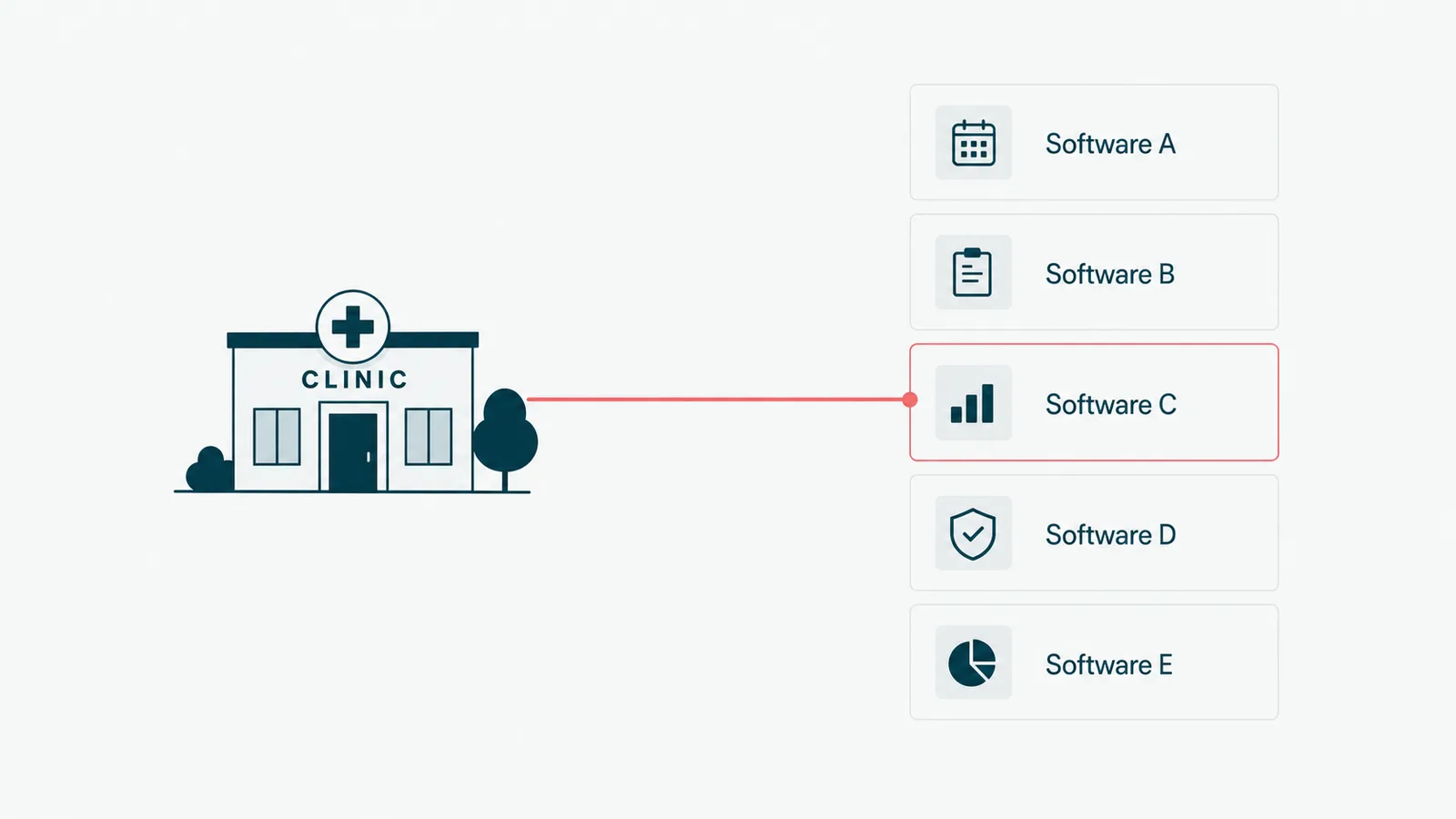
Every EMR demo looks great until you ask it to handle an untimed treatment code, a cueing hierarchy, and a school district's IEP reporting cycle in the same week. Then the sales engineer gets very interested in their own screen share. (Fluent software is rarer than fluent marketing, and we have sat on both sides of that call.)
So this page does not crown a winner. There is no single best EMR for speech therapists, because speech-language pathology spans Medicare Part B outpatient clinics, cash-pay teletherapy, pediatric multidisciplinary practices, early intervention, and school contracts. Those five businesses bill differently, document differently, and get audited differently. The right system is the one that matches your payer mix and your caseload shape.
Below: the six categories of system SLPs actually choose between, a comparison table across the criteria that cost money later, a decision framework with real thresholds, and a demo checklist you can take into a vendor call.
The short answer, by practice type
If you bill mostly Medicare Part B and commercial insurance from an outpatient clinic, a rehab-therapy platform built for PT, OT, and SLP is the default choice. The claims logic already knows about therapy modifiers and annual thresholds.
If you run cash-pay or small-panel teletherapy, a general behavioral and mental-health practice platform is usually the cleanest option. Faster to set up, less billing machinery you do not need.
If you contract with school districts, your real constraint is IEP goal reporting and the district's data agreement, not claim scrubbing.
If you run a multi-site pediatric practice with SLP, OT, PT, and behavioral services in one building, you are shopping for a pediatric therapy platform and you will care about authorization tracking more than anything else.
And if your operation has outgrown all of them, which happens more often than vendors like to admit, you build the part that is breaking and integrate the rest. More on that further down.
The six options speech therapists actually choose between
These are product categories, not brands. Brands move between categories as they add modules, and the category is what determines whether the fit is structural or cosmetic.
- Rehab-therapy platforms for outpatient PT, OT, and SLP clinics.
- Behavioral and mental-health practice platforms used by private-practice SLPs.
- Pediatric and multidisciplinary therapy platforms, often ABA-adjacent.
- Teletherapy-first platforms with built-in video and activity libraries.
- School-based special education systems owned by the district, not by you.
- A custom EMR built around your own workflow, integrated with the rest.
Why category beats brand in this decision
A platform designed for physical therapy assumes timed units and the eight-minute rule. Much of speech-language treatment is billed with untimed, session-based codes such as 92507 for individual treatment, 92508 for group, and 92526 for swallowing treatment. When an EMR's note engine is built around timed units, SLP documentation ends up living in a free-text box that the biller cannot read and the auditor cannot follow.
That mismatch is structural. No amount of template tweaking fixes it. Which is why "we support SLP" deserves one follow-up question: show me the note for an untimed code, and show me where the units come from.
Comparison table: what to weigh before the demo
| Option | Fits best when | SLP note and goal structure | Billing and claims | Teletherapy | Data access and export | Setup effort |
|---|---|---|---|---|---|---|
| Rehab-therapy platform (PT/OT/SLP) | Outpatient clinic, Medicare Part B and commercial payers | Therapy-oriented, often timed-unit first, SLP templates vary by vendor | Strongest category for therapy claims, modifiers, and authorization limits | Usually an add-on module | Reporting is common, full documentation export varies, ask for the spec | Weeks, plus payer enrollment |
| Behavioral and mental-health practice platform | Solo or small-panel private practice, cash-pay or a few payers | Generic clinical note, goals often free text | Claim submission for common outpatient codes, lighter therapy-specific logic | Typically native | Client-level export common, API access varies | Days |
| Pediatric and multidisciplinary therapy platform | SLP plus OT, PT, or behavioral services under one roof, high authorization volume | Discipline-specific templates and structured data collection in some products | Authorization and unit tracking across disciplines is the differentiator | Varies | Multi-discipline reporting, export depth varies | Weeks to months |
| Teletherapy-first platform | Remote caseload, activity and materials delivery matter | Session notes tied to activity records | Often lighter, sometimes paired with a separate biller | Native and central to the product | Recording and media retention policies need review | Days |
| School-based special education system | Your caseload sits inside a district contract | IEP goals and progress reporting are the native model | School Medicaid billing where the district supports it | District-dependent | District owns the record, FERPA governs it, your access ends with the contract | Set by the district |
| Custom EMR, integrated | Multi-payer, multi-site, or a program you license to other clinics | Built to your own goal hierarchy and trial-level data model | Built against your actual payer rules, or integrated with an existing clearinghouse | Built or integrated | You hold the database and the export path | Months, phased |
Comparison is by product category rather than by brand. Feature availability differs by vendor, plan tier, and contract, so verify every row against your own payer mix during the demo.
The number worth knowing before you ask about certification
As of 2021, the Office of the National Coordinator for Health IT reported that 96 percent of non-federal acute care hospitals and 78 percent of office-based physicians had adopted a certified electronic health record. Outpatient therapy software sits outside that pattern, because ONC certification criteria were written around physician incentive programs that most SLP practices never participated in.
Practical consequence: do not assume your shortlist is certified, and do not assume it matters. Look the product name up on the Certified Health IT Product List and decide. If you accept hospital referrals and need to send or receive structured records, certification is a real signal. If you are a cash-pay teletherapy practice, it is a sticker.
A decision framework with actual thresholds
Vendors give you feature grids. Here are the rules we use when a practice asks us which way to go.
If Medicare Part B is more than roughly 40 percent of your visits, pick a rehab-therapy platform. The Centers for Medicare and Medicaid Services require the KX modifier once a beneficiary passes the annual per-year threshold for combined physical therapy and speech-language pathology services. A system that tracks that running total per beneficiary saves you denials that a generic practice platform will happily let you earn.
If you are under five clinicians, cash-pay or two or three payers, choose on speed. A behavioral-health practice platform you can configure in a week beats a therapy platform you will configure for a quarter.
If you hold school contracts, start from the district. The record usually lives in the district's system under FERPA, not in your clinic EMR under HIPAA. Running your own clinical record in parallel is fine, duplicating the IEP goal tracking is not. Pick a system that can import your goal set, or accept the double entry and staff for it.
If you run more than one discipline and more than one authorization type, authorization burn-down is your top criterion. Not notes. Not scheduling. The practice loses money in the gap between units authorized and units delivered.
If a single workflow eats more than eight hours per clinician per month and no vendor on your list supports it, build that piece. Not the whole EMR. The piece. Trial-level data capture, outcome reporting, referral intake from a hospital, parent progress summaries. Build one, integrate it, keep the rest.
And the rule of thumb we trust most: if your workaround spreadsheet has more than one tab per clinician, you are already maintaining software. You are just maintaining it badly, at the worst possible hourly rate, with no tests.
What SLP documentation actually needs from an EMR
Speech therapy outcome data is structured by nature and stored as prose by habit. A clinician records 8 of 10 trials at the phrase level with moderate verbal cueing. That is three structured fields and a timestamp. Most systems take it as a paragraph.
The cost shows up later. When a payer requests documentation for a continued-authorization review, or when you want to show a district that your program works, you cannot query a paragraph. Someone opens 200 notes and counts by hand. We have been hired to fix exactly this, and the fix is boring: a goal has a target behavior, a criterion, a cueing level, and a measurement unit, and every session writes rows against it.
Ask any shortlisted vendor three questions about documentation.
- Where does trial-level data live, as structured fields or as text in the note body
- What happens to a signed note when a clinician needs to correct it, an addendum with version history or a silent edit
- Can a report return progress across a goal for a date range, without an export to a spreadsheet
The second one is a compliance question wearing a usability costume. The HIPAA Security Rule requires audit controls at 45 CFR 164.312(b), and the HHS guidance on the Security Rule is the reference your auditor will use, not the vendor's brochure. A system that lets a signed note change without a trail is a system that will make a records request unpleasant.
Billing is where therapy EMRs earn or lose their keep
Three things separate therapy billing from general outpatient billing, and they are the three things to test in a demo.
Untimed codes. Confirm the system can produce a one-unit claim for 92507 on a 45-minute session without the clinician fighting a timed-unit grid.
Running thresholds and modifiers. Confirm the system tracks per-beneficiary annual totals across disciplines and prompts the KX modifier at the right point, rather than leaving it to the biller's memory.
Evaluation versus treatment logic. Confirm that evaluation codes such as 92523 and swallowing codes such as 92610 carry the documentation requirements the payer expects, and that the system blocks a claim that is missing them. ASHA maintains payer and coding guidance in its Practice Portal that is more current than any vendor page, and it is the right source to check your own code set against.
One more demo request that separates the serious vendors from the rest: ask to see a sample 837P claim file the system generates, and ask which clearinghouses it submits through. If nobody on the call can answer, you are talking to marketing. That is fine, just ask for the integration engineer.
The data-ownership question nobody asks until year three
Every vendor says you own your data. Fewer vendors can tell you the shape it comes out in.
The question that gets a real answer: if we terminate the contract, what exactly do we receive, in what format, within how many days, and does it include the body text of every clinical note or only metadata and a PDF bundle. Get it in writing before signing, because asking during a migration is asking at the worst possible moment.
Then ask about the API. Read access to appointments is common. Read access to documentation content is less common. Write access is rarer still. If your plan involves a parent-facing progress view, an intake form that posts into the chart, or an analytics layer over outcomes, the API surface decides whether that plan is a project or a fantasy. We do a lot of healthcare API and HL7 FHIR integration work, and the pattern is consistent: the integration is never as hard as the vendor's rate limits and export gaps make it.
Retention is the other quiet one. HIPAA requires certain documentation be retained for six years under 45 CFR 164.316(b)(2), and state and payer rules for minors often run longer. If your caseload is pediatric, retention is not a footnote. It is a storage and access design decision.
When a custom EMR is the right call, and when it is not
You do not need a custom EMR to run a speech therapy practice. Most practices should buy. We will say that plainly, because telling a four-clinician clinic to build their own charting is how consultants get a reputation.
Building makes sense in four situations.
You license your methodology to other clinics, and the software is part of the product. A goal bank and a data model are intellectual property. A vendor's template library is not.
You operate across payer types at scale, with school contracts, Medicaid, commercial, and cash in the same organization, and no single system handles all four without parallel spreadsheets.
Your clinical program has structure no vendor models. Multilingual assessment, AAC device programming records, intensive fluency programs, dysphagia protocols tied to instrumental findings.
Or you have an integration spine already and need one well-built piece in it, which is the most common version and the cheapest.
When we build in this space, the work is HIPAA-aware software development from the first commit: role-based access, audit logging on every read and write of PHI, encryption at rest and in transit, Business Associate Agreements with every subprocessor, and release approvals with a record of who shipped what. Not bolted on at the end, when it costs five times more and still looks bolted on.
What we build for speech and language practices
Our team builds clinical systems on .NET and Azure, with React front ends, and we integrate with the EMRs and clearinghouses already in place rather than demanding a rip and replace. Typical engagements for therapy organizations look like this.
A structured outcomes layer that reads session data and produces payer-ready and district-ready progress reports. A referral intake pipeline that takes HL7 or FHIR messages from a hospital system and lands them in the schedule. A parent portal for home practice assignments and progress visibility. Authorization tracking that burns down units across disciplines and warns before you deliver care nobody will pay for. Scheduling logic for recurring therapy blocks, which sounds simple until you meet a caseload with 40 recurring slots, three therapists, two locations, and a school calendar.
We scope these in a discovery phase with a fixed deliverable, then build in phases you can stop between. Eleven years of building software, including leading a FinTech engineering team at a Big Four firm, taught us that the phase you can cancel is the phase a client trusts.
A demo checklist you can print
- Shows a one-unit claim for an untimed treatment code without a timed-unit workaround
- Tracks the annual combined PT and SLP threshold per beneficiary and prompts the KX modifier
- Stores trial data, cueing level, and criterion as structured fields, not note text
- Produces a goal progress report across a date range without a manual export
- Handles a correction to a signed note as a versioned addendum
- Logs reads as well as writes of PHI, and lets you review the log
- Names the clearinghouses it submits through and can show a sample 837P
- States the termination export format, contents, and turnaround time in the contract
- Exposes documentation content through an API, not just appointments
- Signs a Business Associate Agreement covering every subprocessor, including the video vendor
- Supports retention periods for pediatric records under your state's rules
- Appears on the Certified Health IT Product List, if hospital record exchange matters to you
Checklist items are drawn from CMS therapy billing requirements, the HIPAA Security Rule at 45 CFR 164.312 and 164.316, and ONC's Certified Health IT Product List. Use it as a scoring sheet across vendors rather than a pass or fail.
Related work
- Custom healthcare software development, for clinical systems built around a workflow no vendor models
- EHR and EMR software development, for charting, scheduling, and documentation builds
- HIPAA-aware software development, for audit logging, access control, and BAA coverage
- Healthcare API and FHIR integration, for referral pipelines and connecting the systems you keep
Pick the category, score the vendors on the checklist, and ask the export question before you sign rather than after. Do that and your next EMR migration will be the quietest project of the year, which in this field counts as a standing ovation.