Medical billing runs on claims, denials, and the seventeen systems that have to agree with each other before a payer releases money. Get the software wrong and the symptom is always the same: a finance team that closes the month three weeks late and a denial rate that reads like a one-star review. This page compares the real options for building medical billing software, not the brochure each vendor wrote about itself.
Short version: buy off-the-shelf if your specialty is common and your payer rules are standard, hire in-house only if billing logic is genuinely your differentiator and you can retain senior healthcare engineers, and go custom when you are integrating multiple EHRs or building billing as a product other people rely on. The rest of this page is how to tell which one is you, and what each path quietly skips.
What "medical billing software development" actually means
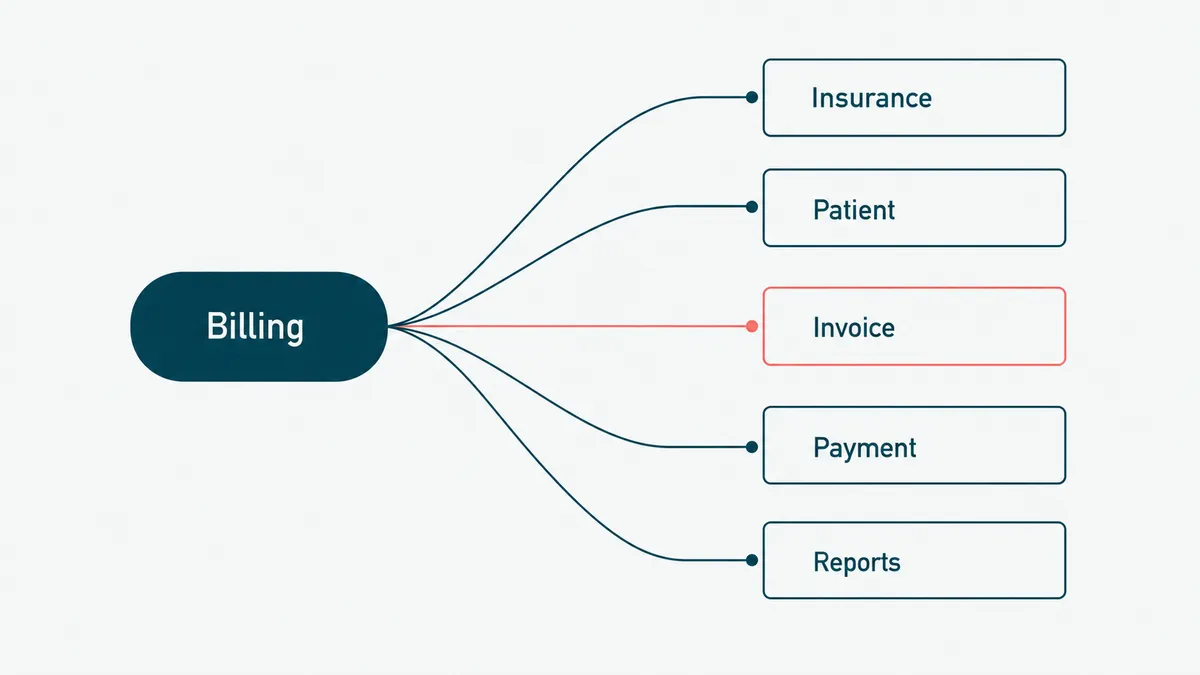
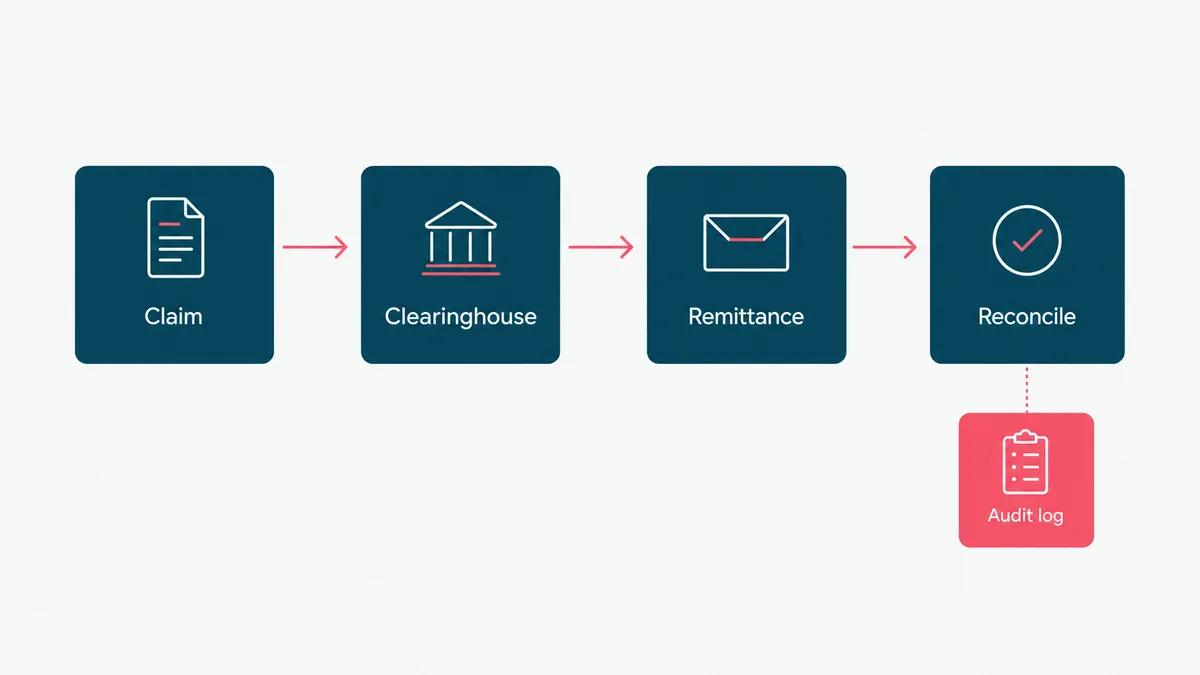
Medical billing software is not one product. It is the layer that turns a rendered service into a paid claim: charge capture, eligibility checks, claim scrubbing, EDI 837 submission, ERA 835 posting, denial management, and patient statements, all of it wired into a clearinghouse and, usually, an EHR.
Buy the wrong shape of tool here and you inherit someone else's assumptions about your specialty, your payer mix, and your workflow. Build the wrong way and you inherit a maintenance bill that outlives the original developer's enthusiasm. The 837 and 835 transactions in the middle of all this are maintained as national standards by X12, and CMS mandates them for HIPAA-covered electronic claims, which is a polite way of saying the format is not negotiable and getting it slightly wrong gets your claim rejected before a human ever reads it.
Walk one claim end to end and you can see why. A provider renders a service. The software captures the charge, checks that the patient's coverage is active, scrubs the claim against that payer's rules, and formats an 837 that the clearinghouse forwards to the payer. Days later an 835 remittance comes back with a payment, an adjustment, or a denial code, and the software has to post it, reconcile it against what was billed, and decide whether the leftover balance goes to a secondary payer or the patient. Each of those steps is a place a claim can stall, and every stalled claim is money sitting still. The whole reason to care about the software is that the manual version of this loop is where practices quietly lose a slice of every dollar they earn, one keystroke and one missed follow-up at a time.
The five paths teams use to get this built
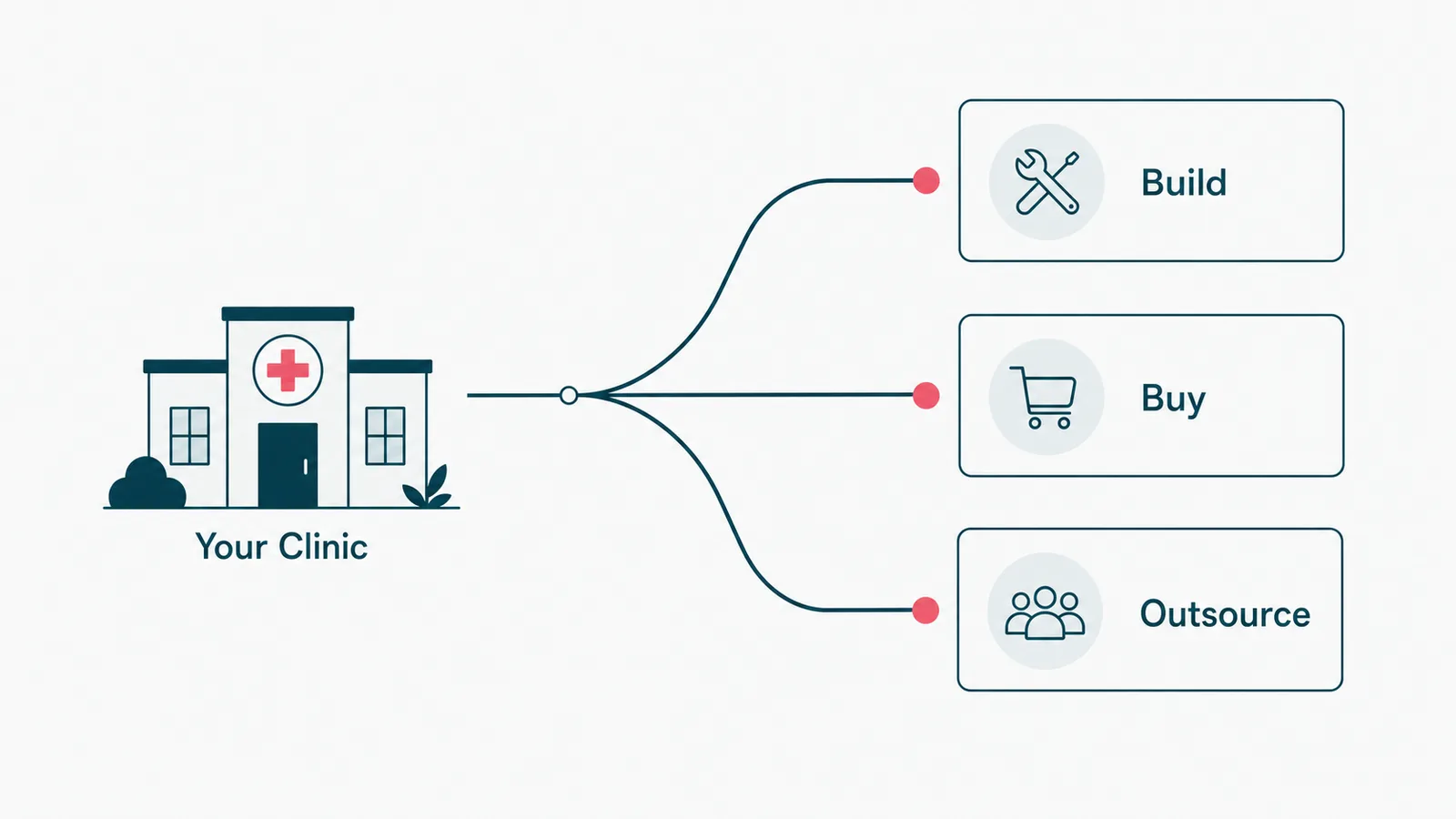
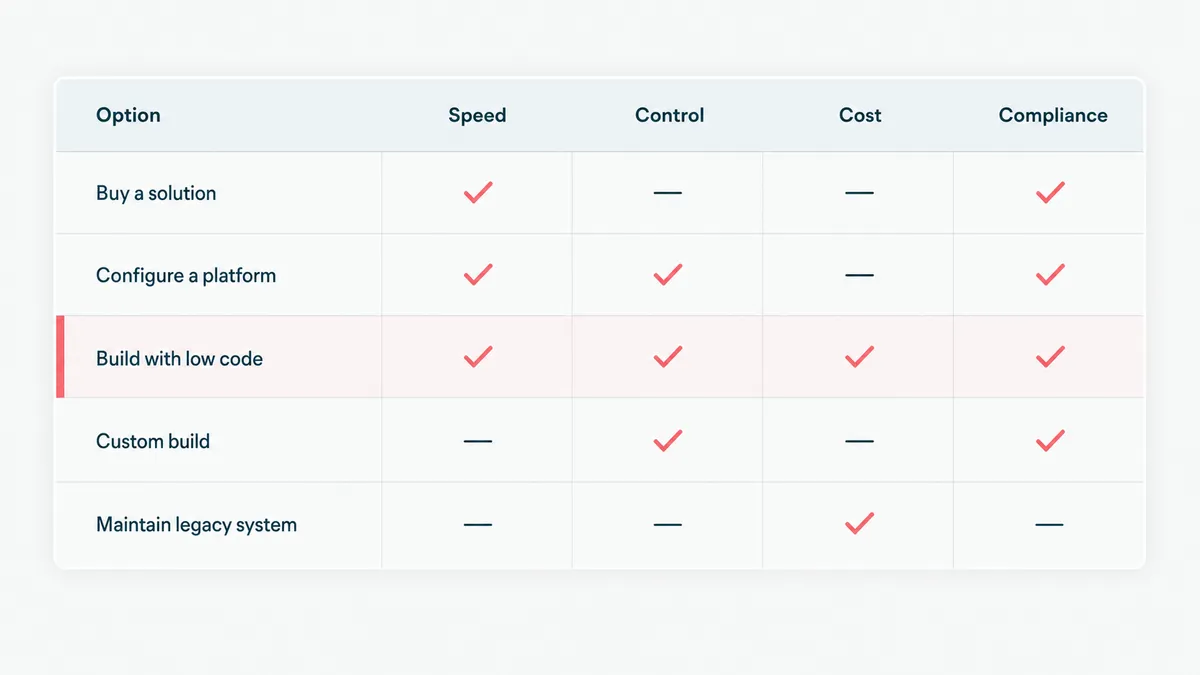
Everyone building or buying medical billing software is choosing between five paths. None is wrong in the abstract. Most are wrong for a specific practice, payer mix, or growth stage, which is the only context that matters.
The first path is off-the-shelf billing software: a vendor-built product, usually priced per provider or per claim, that covers common specialties well and uncommon workflows not at all. The second is an in-house hire or a small internal team, where you own the roadmap completely and also own recruiting, retention, on-call, and the bus-factor risk of one engineer being the only person who knows where the claims logic lives. Third is an offshore outsourced shop: cheaper day rates, variable seniority, and a review process that ranges from rigorous to nonexistent depending entirely on who you happen to book. Fourth, a low-code or no-code platform, which is fast to a demo and fast to a wall the moment your billing rules need a real state machine instead of a workflow builder.
The fifth is custom development with a senior engineering partner: a dedicated team builds to your payer mix, your specialty, and your existing stack, with the compliance and audit discipline healthcare software actually requires. That is the path this page is honest about, because it is the one we do.
Medical billing software development options compared
| Option | Time to first claim submitted | HIPAA and audit-trail readiness | Claims and clearinghouse integration | Customization ceiling | Ongoing cost shape | Best fit |
|---|---|---|---|---|---|---|
| Off-the-shelf billing software | Fast, days to weeks | Vendor-managed, limited visibility into internals | Pre-built to major clearinghouses, rigid mapping | Low, configuration only | Predictable per-seat or per-claim fee | Single-specialty practices with standard payer rules |
| In-house team | Slow, months to first release | As strong as the team you hire and retain | Custom-built, quality depends on team's healthcare EDI experience | High, but bounded by team size | Salary, benefits, tooling, and retention risk | Organizations with billing as a core, long-term differentiator |
| Offshore outsourced shop | Variable, depends on vendor's actual seniority | Inconsistent, ranges from careful to absent | Ranges from solid to brittle, hard to assess up front | High on paper, risky in delivery | Lower day rate, higher rework and oversight cost | Teams with strong in-house technical leadership to manage the vendor |
| Low-code / no-code platform | Very fast for a prototype | Limited, most platforms are not built for PHI-heavy audit trails | Basic, breaks down on complex claim scrubbing logic | Low, hits a wall past simple workflows | Cheap early, expensive to extend or migrate off | Early validation before committing to a real build |
| Custom development with a senior partner | Weeks to an MVP, not months | Built with HIPAA-aware architecture, access control, and audit logging from day one | Purpose-built to your clearinghouse, payer rules, and EHR | High, matched to your actual workflow | Fixed-scope delivery, then a clear support model | Multi-specialty groups, growing practices, or platforms where billing is the product |
Which option fits your situation
If your specialty is common and your payer rules are standard, off-the-shelf software is the quickest option. Do not custom-build what a vendor already sells well.
If billing logic is genuinely your differentiator and you can recruit and retain senior healthcare engineers, an in-house team makes sense. Most organizations underestimate the retention part, which is the expensive half.
If you have a strong technical lead in-house who can review architecture and code, an offshore shop can work as extra capacity under your own oversight. Without that lead, you are buying risk at a discount.
If you need to validate a workflow before committing budget, a low-code platform is a fine sandbox. Treat it as a sandbox. Do not build your production claims engine on a tool designed for internal approval forms.
If your billing needs do not fit a standard template, if you are integrating multiple EHRs, or if billing is core to a healthcare platform you are building for other people, custom development with a senior partner is the option built for that. This is where HighCraft works.
A useful gut check: the more of your revenue depends on billing behaving correctly, the further up that list you should sit. A single-specialty clinic where billing is a back-office cost center is well served by a vendor tool and should not romanticize a custom build. A SaaS company whose entire product is billing for other practices has billing as the thing customers pay for, and a rejected claim is not an internal annoyance, it is a support ticket with someone else's revenue attached. Those two are not choosing between the same options, even though they are shopping in the same market. Match the path to how much a wrong claim actually costs you, not to what sounds impressive in a board update.
The half of billing that never makes the demo
Here is the story that reset how we scope any billing build.
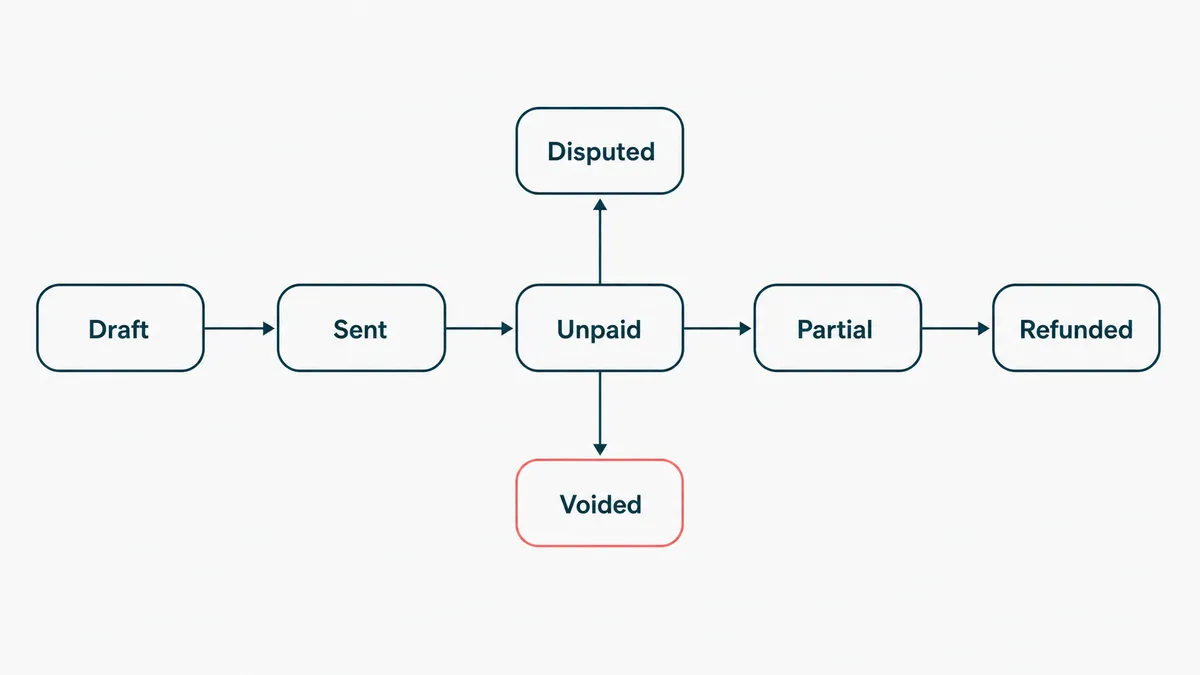
We started one healthcare platform's billing as a simple invoice tool. Charge, send, mark paid. A weekend feature, the kind that demos beautifully. Then real money moved through it, and the polite fiction fell apart. A card payment can succeed, fail, refund, partially refund, or come back as a dispute weeks after everyone has moved on, and ACH adds its own slow-settling states underneath all of that. The invoice was never an invoice. It was a state machine wearing an invoice costume.
So we modeled it as one, with every unglamorous state written down: draft, sent, unpaid, partially paid, refunded, voided, disputed. Seven states. Stripe events reconcile against the platform's own records, and every transition lands in an audit log, because when a number looks wrong at month end you need to prove which event changed it and when. The full retelling is in the boring half of payments, and it is the closest thing we have to a billing manifesto.
The lesson generalizes, and it is the one opinion I will push on this page: a feature is its states, not its screen. The demo shows the happy path, the one green checkmark where money arrives. The product is the other six states, the ones nobody wants to talk about in the sales meeting. That gap is exactly why an honest billing quote looks bigger than a pretty one. It is counting the disputed-payment state that a prettier quote quietly pretends cannot happen. Get one state wrong and someone is double-charged while someone else spends an afternoon reconciling by hand, and now your billing software has generated the exact problem it was bought to prevent.
Medical billing is that same shape with a clearinghouse bolted on. A claim is not "submitted" or "paid." It is accepted, rejected, pended, partially paid, denied, appealed, resubmitted. Count those states before you price the screens, or the states will count themselves later, in overtime.
Where billing builds actually go wrong
The failures are predictable, which is the good news, because predictable means avoidable if someone names them out loud before the kickoff call.
The first is testing against a sandbox instead of your clearinghouse. A generic EDI sandbox will happily accept an 837 that your real clearinghouse rejects, because the sandbox does not enforce the payer-specific companion guides that turn a valid-looking claim into a rejected one. A build that passed every test and fails on the first live batch usually failed here. You want the integration exercised against the thing it will run against, early, while changing it is still cheap.
The second is treating eligibility as optional. Checking coverage before the claim goes out is unglamorous and easy to defer, and deferring it is how you generate a denial you could have prevented for free. A denied claim does not just cost the payment. It costs the staff time to work it, the delay before resubmission, and the real chance it ages past the payer's timely-filing window and becomes uncollectable. The eligibility check is the cheapest denial you will ever avoid.
The third is a denial workflow that is really just an inbox. Denials arrive as codes on the 835, and a system that dumps them into a shared folder for someone to notice is not managing denials, it is postponing them. The states pile up, the follow-ups slip, and the aging report starts to look like a lesson in compound interest running the wrong direction. Routing, tracking, and resubmission have to be part of the build, not a manual process taped to the side of it.
The fourth is a rules engine that hard-codes today's payer rules. Payer requirements change, and a scrubbing layer that treats them as constants becomes a source of denials the moment a payer updates a policy. The rules need to be data you can edit, not logic you have to redeploy. This is the same reason a low-code workflow builder eventually fails at claim scrubbing: it can encode a rule, but it cannot hold a real rules engine that a biller can update without an engineer in the loop.
None of these are exotic engineering problems. They are the parts a demo-shaped build skips because they do not photograph well, and they are exactly the parts that decide whether the software makes money or just makes screens.
What custom medical billing software has to get right
A billing system that ships fast and breaks on the first denial reconciliation cycle is not an MVP. It is a liability with a nice UI.
The non-negotiables:
- Correct EDI 837 claim generation and 835 remittance parsing, tested against your actual clearinghouse, not a generic sandbox
- Eligibility verification before the claim goes out the door, not after it comes back denied
- Claim scrubbing rules that reflect your specialty's real payer requirements, not a generic rules library
- Audit trails on every claim edit, every user, every timestamp, because an auditor eventually asks
- Role-based access control so billing staff, providers, and admins see exactly what they need and nothing more
- A denial management workflow that routes, tracks, and resubmits, instead of dumping denials into a shared inbox where they go to age
None of that is exotic. All of it is easy to skip when the goal is a demo instead of a system someone runs payroll against. It is also why the compliance floor matters from the first commit: HIPAA's Security Rule from HHS governs how PHI is stored, transmitted, and logged, and access control plus audit logging are the two requirements retrofitting punishes hardest.
Where HighCraft fits in this comparison
We build custom medical billing software for healthcare and SaaS teams whose workflow has outgrown the off-the-shelf option. Our team ships on .NET and Azure, with Stripe where payment processing sits alongside billing, and we build HIPAA-aware from the architecture up, not bolted on the week before a compliance review.
We run discovery before we write code, so the scope you get quoted is the scope you get built. Releases go through code review and approval, with audit trails on the delivery process itself, which matters when your product's whole job is producing an audit trail for someone else. This connects to the wider work we do: custom healthcare software development, healthcare API and EDI integration, HIPAA-compliant engineering, and payments and billing systems when the money side needs its own state machine.
If your spec is genuinely frozen and simple, you may not need a discovery sprint at all. If it is not frozen, and for medical billing it rarely is, that sprint is where the payer-mix questions get answered before they get expensive.
Related services
- Custom healthcare software development
- Healthcare API and EDI integration
- HIPAA-compliant software engineering
- Payments and billing systems
- The boring half of payments
If your billing workflow still fits on someone else's template, buy the template and spend the saved budget on something that does not. If it stopped fitting a while ago and you have just been living with the workaround, estimate the project and we will tell you honestly which of the five paths above actually applies to you. We might also make one terrible joke about your denial codes. Consider that a bonus, not a warning.