There is no single best EMR for a small practice. There is a best EMR for your specialty, your billing setup, and how many providers actually log in on a Tuesday. Anyone who tells you otherwise is selling something, usually a demo, and the demo always runs on the one workflow they rehearsed.
We build software for healthcare operators, so we get this question from a different angle than most comparison sites do. Practices email us after they have already tried the top three vendors, and the EMR still does not fit how they actually work. This page covers the platforms worth comparing, what each one really costs, what "best" should mean for your practice, and when the honest answer is that no off-the-shelf EMR will get you the rest of the way.
What "best" actually means for a small practice
Marketing pages talk about features. Practices talk about Mondays. Here is what the decision usually comes down to once the sales calls are over.
- Time to first patient chart, not time to signed contract
- Per-provider cost that stays predictable as you add a second or third provider
- Billing and claims tools tight enough that you are not exporting to a separate clearinghouse
- Specialty templates that match your visit types, not a generic SOAP note
- ONC certification, so you stay eligible for the programs and quality measures that pay you
- E-prescribing that includes controlled substances (EPCS), because a script pad in 2026 is a liability
- Interoperability with labs, pharmacies, and the hospital system down the road
Weigh those against your specialty and your headcount and the shortlist gets short fast.
The EMR platforms worth comparing
Most small practices end up looking at the same handful of names. Each one has a reputation for a reason, and the reason usually tells you who it was built for. Every platform below is certified under the ONC Health IT Certification Program, which is the floor, not a differentiator. What separates them is depth, price, and who they were designed to serve.
athenahealth built its name on revenue cycle work, with a network model that pushes claims data back into the product. It carries strong e-prescribing with EPCS and built-in telehealth, and it is cloud-only. The catch is the pricing model, which is usually a percentage of your collections rather than a flat seat fee.
DrChrono leans mobile-first, popular with practices that chart from an iPad between rooms. It ships EPCS, integrated telehealth, and an open API, which makes it one of the friendlier platforms to build alongside. Deployment is cloud-only.
AdvancedMD markets itself on configurability, which is a polite way of saying you will spend time in the settings menu. It covers EPCS, telehealth, and a deep billing module sold as a separate line item. Cloud-only, and strongest when you actually want to tune the workflows yourself.
Tebra, the product formerly known as Kareo, built its base with solo and small practices that needed billing and scheduling without an enterprise sales cycle. It handles e-prescribing with EPCS and bundles telehealth, and it stays cloud-based. For one to three providers it is the default nobody gets fired for picking.
NextGen Healthcare targets specialty and multi-provider groups with deeper clinical workflows. It supports EPCS, telehealth, and, unusually for this list, both cloud and on-premise deployment if you have a reason to keep data local. That flexibility is why larger specialty groups keep it on the shortlist.
Practice Fusion, now under Veradigm, made its reputation as a low-cost cloud EMR for small practices. It is ONC-certified, includes e-prescribing with EPCS, and offers telehealth, all cloud-based. Its packaging has shifted since the acquisition, which is worth a paragraph of its own further down, because a lot of practices still believe a version of it that stopped being true in 2018.
eClinicalWorks serves everyone from solo practices up to large multi-specialty groups, with EPCS, telehealth, and a broad feature set. It runs in the cloud, and the small-practice experience can feel bigger than it needs to be, because you are getting a system designed to scale to a hospital.
None of these is wrong. Some are wrong for you.
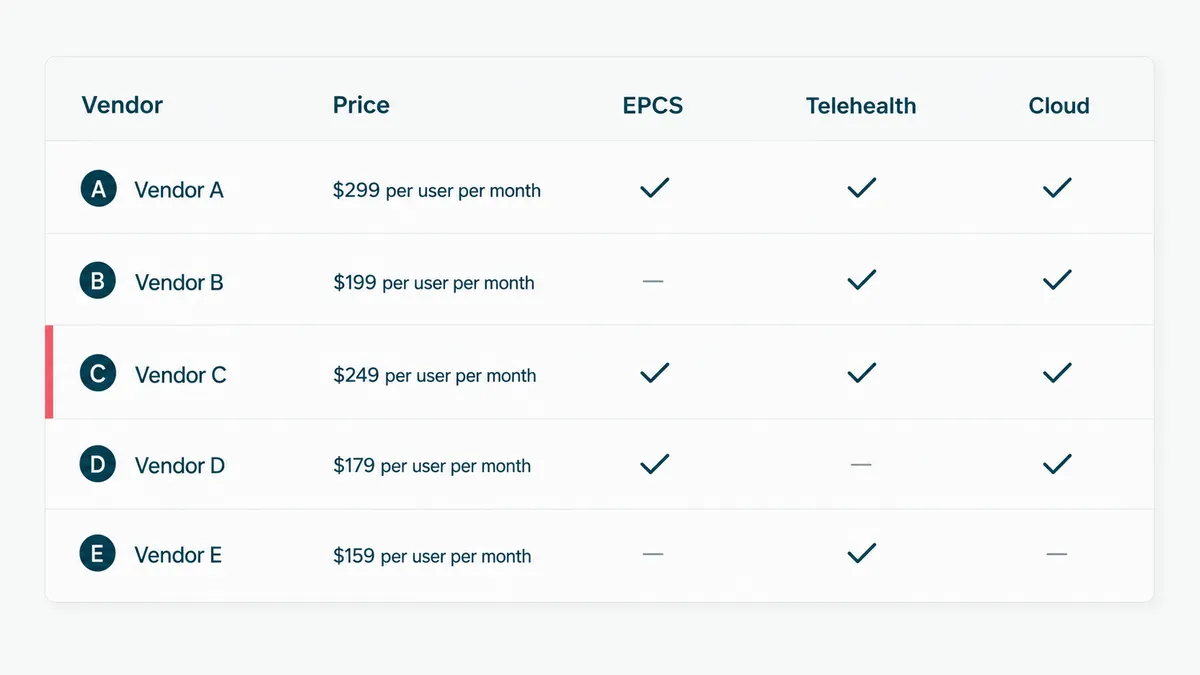
EMR comparison table
| Platform | Best known for | Deployment | Billing / RCM depth | EPCS / telehealth | Typical list price |
|---|---|---|---|---|---|
| athenahealth | Revenue cycle, payer network data | Cloud | Strong, network-driven claims | Yes / Yes | ~4-7% of collections, or from ~$140/provider/mo |
| DrChrono | Mobile and tablet-first charting | Cloud | Built-in, moderate depth | Yes / Yes | From ~$200/provider/mo |
| AdvancedMD | Configurable clinical and billing modules | Cloud | Strong, sold as a module | Yes / Yes | From ~$429/provider/mo |
| Tebra (Kareo) | Solo and small-practice billing | Cloud | Solid, built for small practices | Yes / Yes | From ~$150/provider/mo |
| NextGen Healthcare | Specialty-specific clinical workflows | Cloud or on-premise | Strong, especially for specialties | Yes / Yes | From ~$300/provider/mo |
| Practice Fusion (Veradigm) | Low-cost cloud EMR | Cloud | Basic, third-party billing common | Yes / Yes | From ~$199/provider/mo |
| eClinicalWorks | Broad coverage, scales to large groups | Cloud | Strong, enterprise-grade | Yes / Yes | From ~$449/provider/mo |
The names on this list all claim to be the right fit for a small practice, and on a demo call they all look it. Read the table again with your own patient volume and price ceiling in mind and most of them rule themselves out before you ever pick up the phone.
What these actually cost
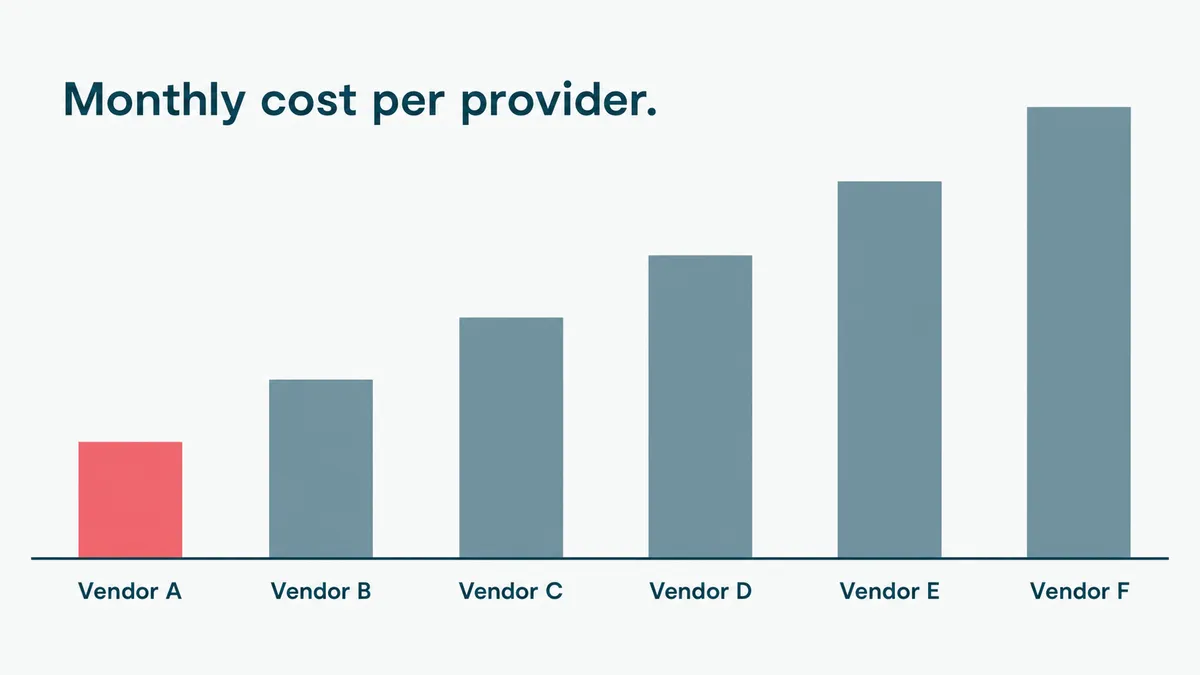
The single most common thing missing from an EMR comparison is a dollar figure, because vendors would rather you find out on a call. Here are published list prices, so you walk in already knowing the shape of the bill.
- Practice Fusion: from about $199 per provider per month under Veradigm. Not free, and the free plan ended back in 2018.
- Tebra (Kareo): from roughly $150 per provider per month, with billing tiers on top.
- DrChrono: from about $200 per provider per month, plans scaling with the feature set.
- NextGen: from around $300 per provider per month, higher for full specialty configurations.
- AdvancedMD: from about $429 per provider per month for the EHR, with billing sold separately.
- eClinicalWorks: from about $449 per provider per month, or a lower base plus a percentage of collections.
- athenahealth: usually a percentage of collections, commonly cited around 4 to 7 percent, with flat-fee options starting near $140 per provider per month.
Two caveats before you build a spreadsheet on these. First, the sticker rarely includes implementation, training, or clinical content subscriptions, which the vendor-neutral cost breakdowns at FindEMR and Capterra put in the low thousands per year on top. Second, list prices move. Check current terms with each vendor for your provider count and specialty before you commit, because the number on a review page is a starting point, not a contract.
The Practice Fusion "free" myth, corrected
This one deserves its own section because half the internet still has it wrong. Practice Fusion did launch as a free, ad-supported EMR, and that is the version people remember. It ended in 2018. Allscripts acquired Practice Fusion in January 2018 for 100 million dollars and moved it to a paid subscription. Allscripts then renamed itself Veradigm in January 2023, so the product now lives under the Veradigm brand.
So if a comparison post or an old forum thread tells you Practice Fusion is free, it is quoting a price that expired eight years ago. It is a fine low-cost option at roughly $199 per provider per month. It is not a free one, and the "free EMR" search that sent a lot of people here is chasing a ghost.
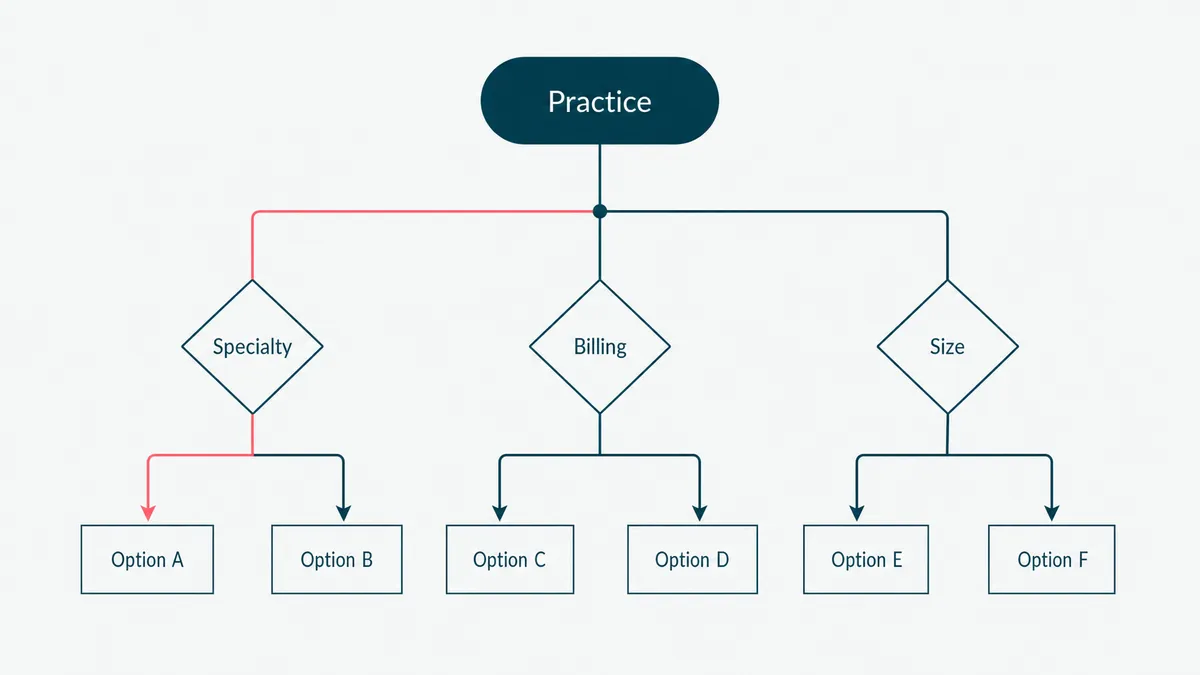
Decision framework: match the EMR to the practice
If you are a solo or two-provider practice
Start with Tebra or Practice Fusion. Both were built with a smaller footprint in mind, and neither will make you pay enterprise onboarding fees for a two-person clinic. Confirm Practice Fusion's current terms directly, since the move under Veradigm changed how it is packaged and priced.
If you run multiple locations or specialties
Look at NextGen or AdvancedMD. Specialty templates and multi-location scheduling matter more once you are not the only person deciding how the system should behave. athenahealth is worth a look here too, particularly if payer mix and claims volume are a bigger headache than clinical templates.
If your practice has outgrown what any EMR vendor offers
This is the group we actually work with. You have tried two or three platforms on this list. Each one covers eighty percent of what you need and charges you for custom work to get the rest, work the vendor's roadmap will never prioritize because you are not their biggest account. At that point the conversation stops being "which EMR" and starts being "what do we build around or instead of the EMR."
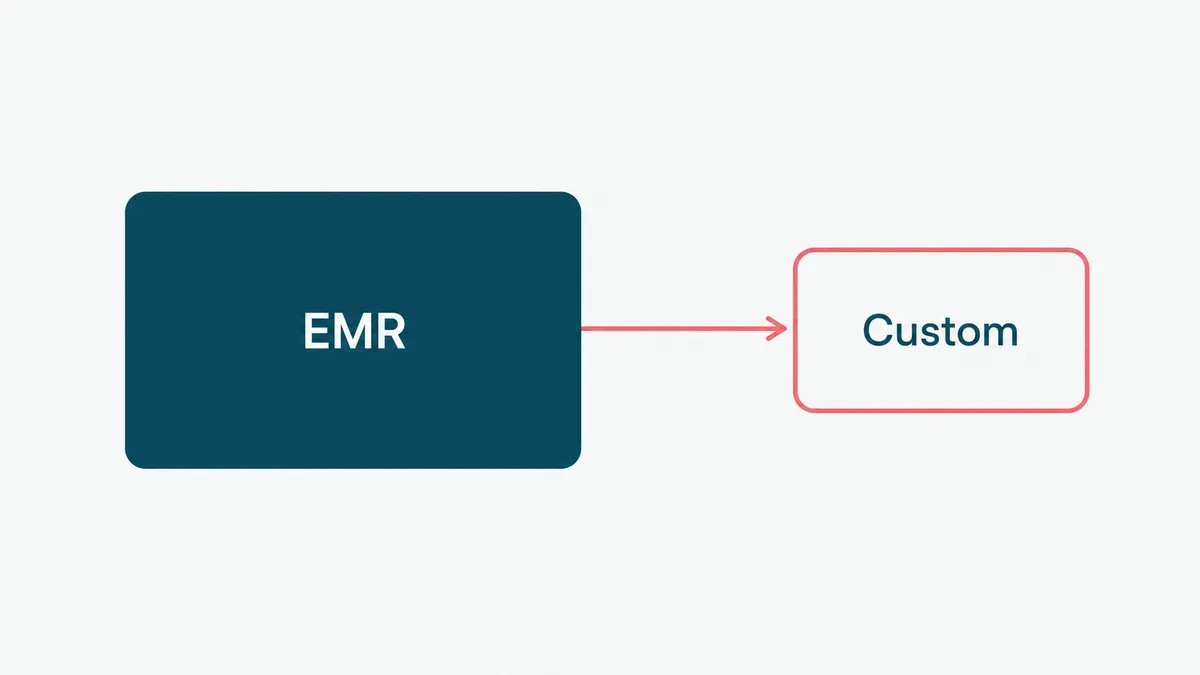
Where a custom build beats an off-the-shelf EMR
Off-the-shelf EMRs are built for the average practice in their target segment. Your practice is not average. It just has a name on the door and a specific way it runs intake, referrals, or a niche billing arrangement that the vendor's template was never designed for.
The tell is usually the same: your staff has a spreadsheet, a second tool, or a manual step that exists specifically because the EMR could not do that one thing. That workaround is not a training gap. It is the EMR telling you it has reached its limit, and no amount of retraining moves that wall.
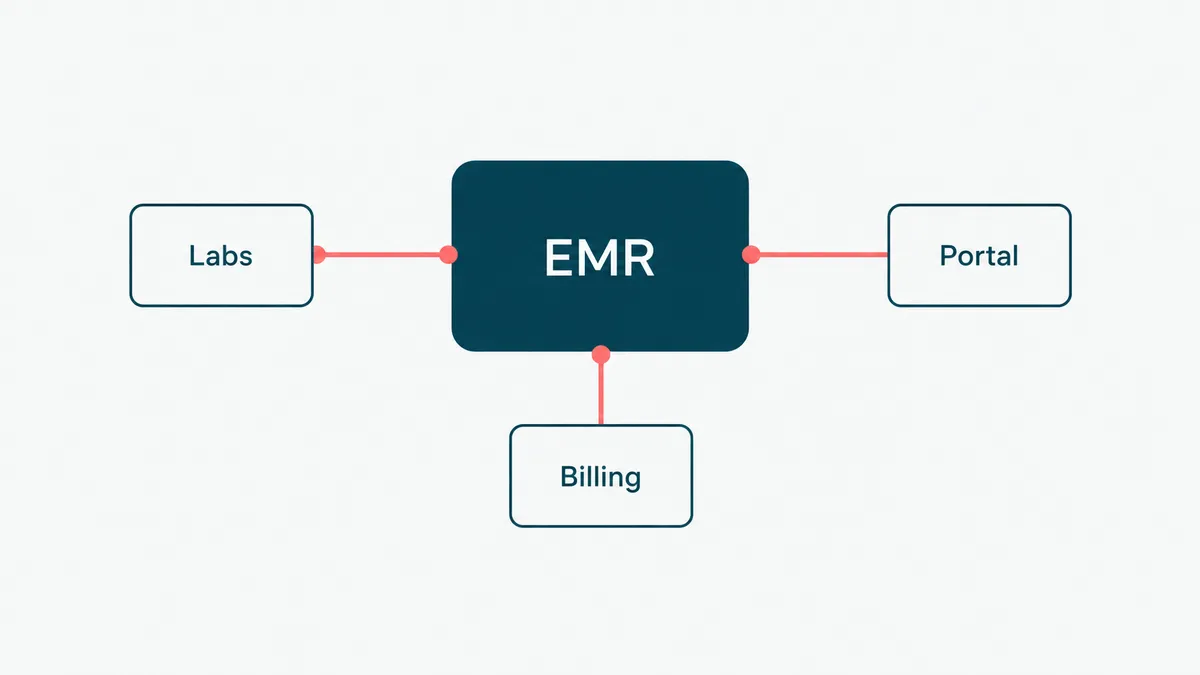
A custom build does not replace your EMR most of the time. It sits next to it: a patient intake flow that actually matches your visit types, a billing rule engine for a payer contract nobody's template anticipated, or an integration that pulls lab results into the chart instead of a fax machine that has been holding the line since the second Bush administration.
What we build when the EMR is the bottleneck
This is where we come in. We build the layer that off-the-shelf EMRs were never going to give you.
That includes HIPAA-aware application development for patient portals and intake tools, HL7 and FHIR integrations that connect your EMR to labs, pharmacies, or a hospital system, custom billing and claims logic for payer contracts the standard module does not model, and reporting dashboards that pull the numbers your EMR's canned reports do not surface. If you want the deeper version of how these systems get built, our guide on how to create EHR software walks through the moving parts, and our EHR software development and custom healthcare software development work is where this lands in practice. We have built this kind of work for healthcare and SaaS operators whose real workflow had outgrown the tool they were sold. A US digital-health platform is a typical shape of client: strong on the clinical side, boxed in on the software side.
We do not sell an EMR. We build the parts around it that make the EMR you already picked actually work the way your practice does.
If your EMR covers most of the job and a workaround covers the rest, book a discovery call and we will tell you honestly whether that gap needs custom engineering or just a better configuration. Either way, you will get a straight answer, and probably one bad joke about your CSV exports.