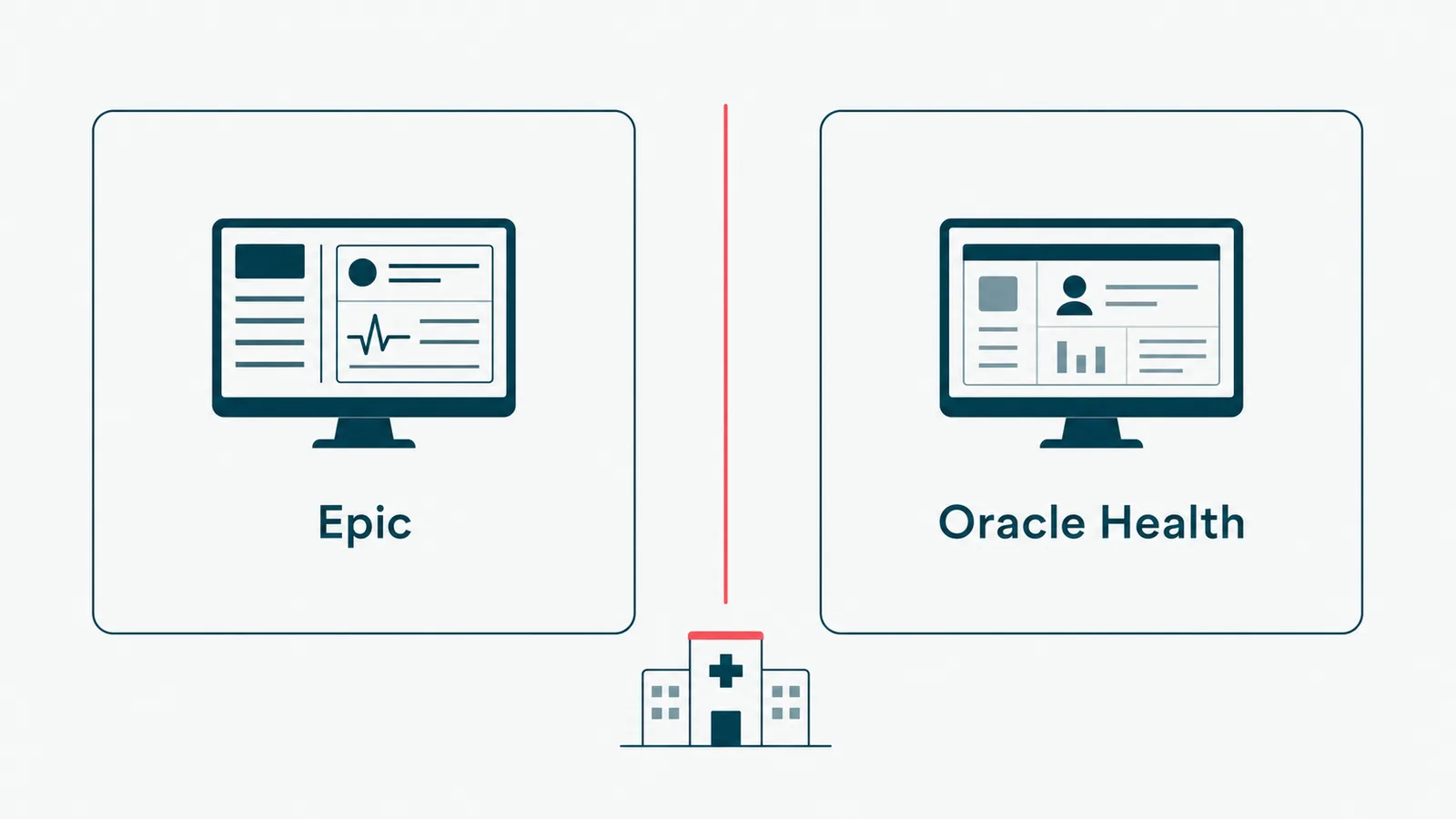
Two names dominate the electronic health record market the way Coke and Pepsi dominate the vending machine: Epic and Cerner, the latter now wearing an Oracle badge like it got promoted mid-shift. Health systems ask us "epic vs cerner" expecting a clean winner. There isn't one. There's a fit question, and it depends on your size, your budget cycle, and how much patience your IT team has for a multi-year rollout.
We build integrations, custom modules, and interoperability layers for both platforms. This page is the comparison we would actually give a client on a call, not a sales sheet from either vendor.
Contents
- The short answer
- What Epic and Cerner actually are
- The market-share numbers nobody wants to quote
- Epic vs Cerner at a glance
- How to choose: a decision framework
- Interoperability and integration
- Cost, contracts, and the total bill
- Implementation timelines
- Where custom engineering closes the gap
The short answer
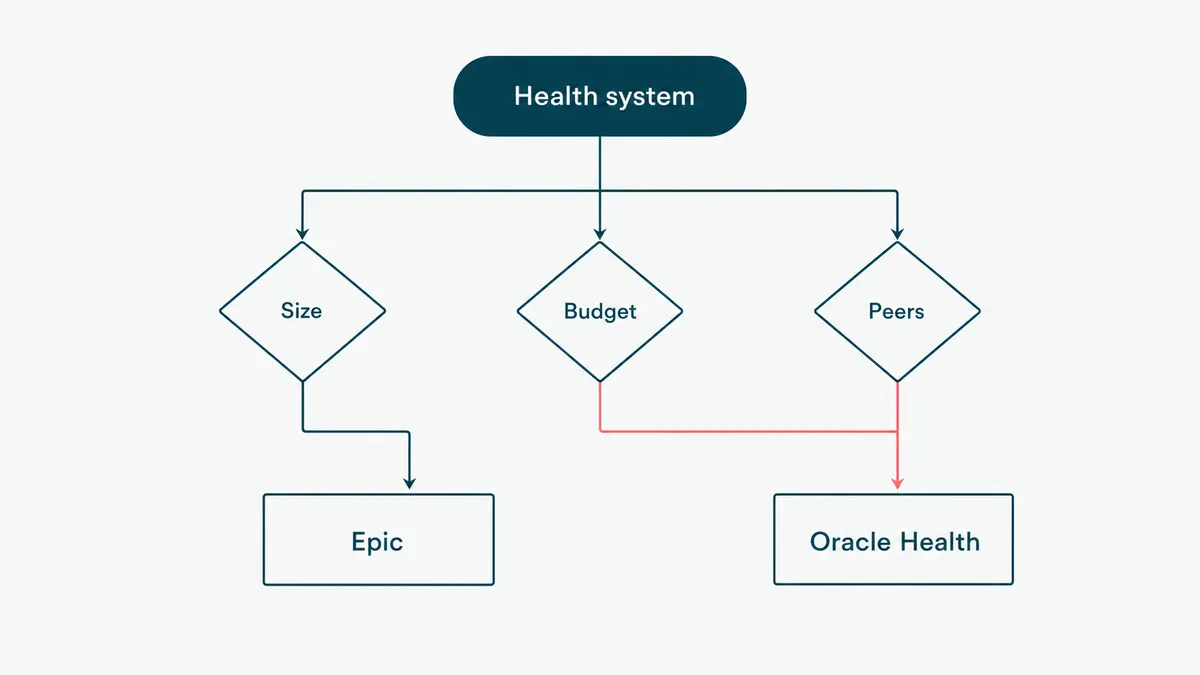
Epic tends to win with large, well-funded health systems and academic medical centers that want one connected database across every department. Oracle Health (Cerner) tends to win with community hospitals, government health systems, and buyers who want more flexibility in deployment and price negotiation. Neither is "better" in the abstract. The question is which garage you already have, which peers you refer patients to, and which one your budget can actually finish implementing.
If you want the numbers behind that framing, they are further down. The KLAS 2026 acute-care market-share report puts Epic well ahead on installed base, and the trend line is still moving in Epic's direction. That matters less than fit, but it is not nothing, and any honest comparison should say the number out loud instead of hiding behind "it depends."
What Epic and Cerner actually are
Epic is privately held, built on its own Chronicles data model and a Caché-derived database, and known for keeping its architecture tightly controlled. One vendor, one codebase, one very long implementation contract. Its patient portal, MyChart, has become close to a household name, which is either impressive marketing or proof that patients now recognize their hospital's software brand better than their hospital's name. Possibly both.
Cerner built its Millennium platform as a more modular system and has a long history with government health systems, including large federal contracts. Oracle acquired Cerner and has been folding it into Oracle Health, which means the branding is mid-transition and some of your vendor conversations will still use both names interchangeably. The patient portal followed the same path: what was HealtheLife is now the Oracle Health Patient Portal (formerly HealtheLife), renamed in October 2024. Expect the naming drift to continue for a while. Software rebrands slower than everyone hopes.
The market-share numbers nobody wants to quote
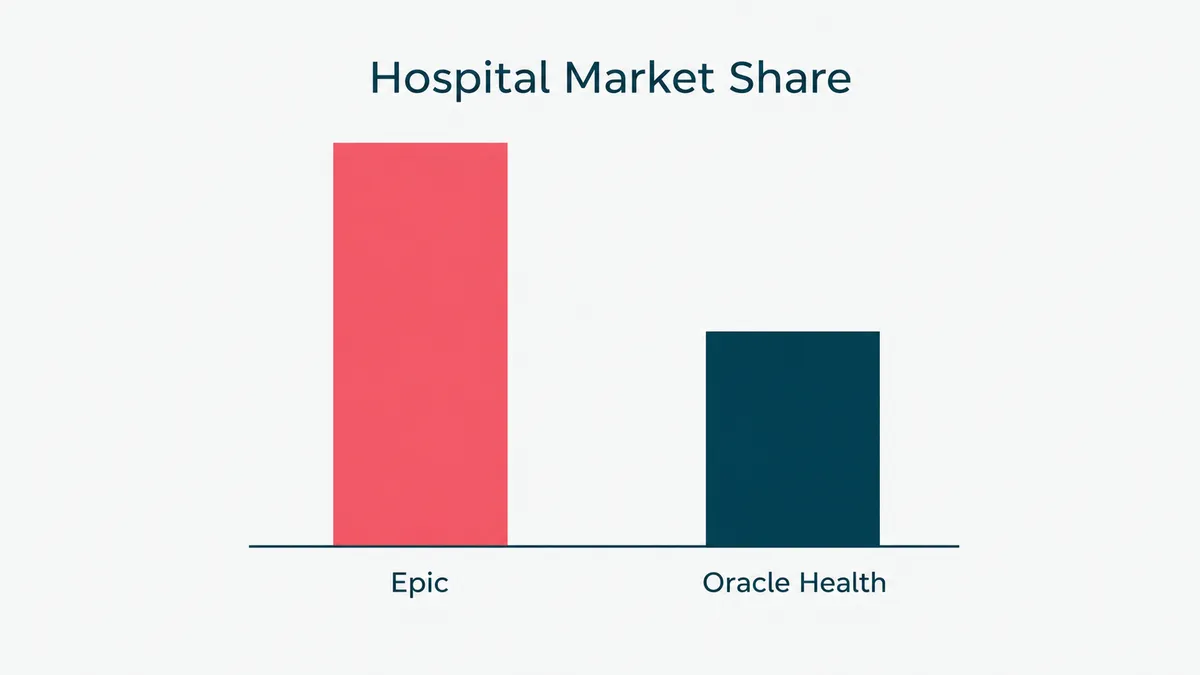
Here is the part most comparisons skip, because the number is unflattering to one side and vendors prefer a tie. According to the KLAS 2026 acute-care EHR report, Epic holds 43.7 percent of US hospitals and 56.9 percent of hospital beds. Oracle Health (Cerner) holds 21.9 percent of hospitals and 20.4 percent of beds. Epic runs roughly one in every two hospital beds in the country. That is not a rounding error, and it is worth knowing before you walk into a room where a salesperson tells you the two platforms are neck and neck.
The direction of travel matters more than the snapshot. Oracle Health posted the largest net hospital loss of any acute-care EHR vendor for the third year running, down 56 hospitals in 2025, while Epic added hospitals and beds the same year. Customer satisfaction with the Millennium platform has been sliding through the post-acquisition layoffs and restructuring, which shows up in the Best in KLAS 2026 scoring as the weakest read among the major acute-care systems. None of that makes Millennium a bad platform for the right buyer. It does mean the momentum question has a clear answer, and pretending otherwise does a health system no favors.
Read those numbers as weather, not destiny. A community hospital that shares a region, a lab network, and a referral pattern with three other Oracle Health sites may still be right to pick Oracle Health, market trend or not. Fit beats share. But you should choose against the real numbers, not around them.
Epic vs Cerner at a glance
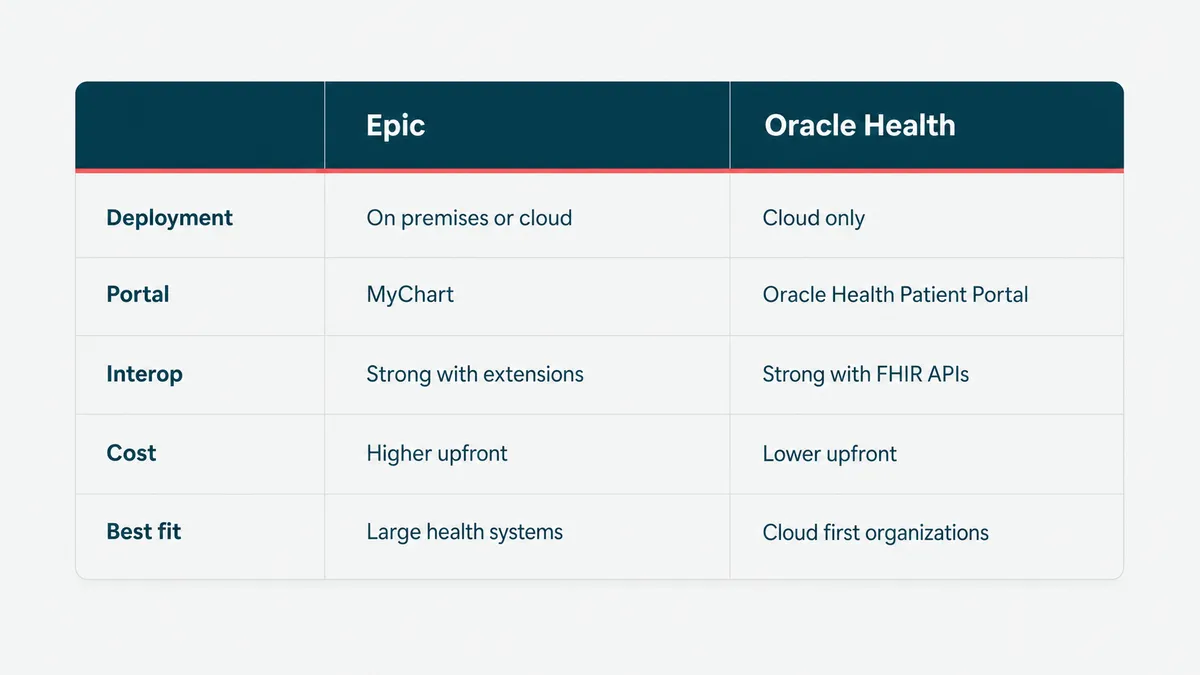
| Criterion | Epic | Cerner (Oracle Health) |
|---|---|---|
| Acute-care market share (KLAS 2026) | 43.7% of hospitals, 56.9% of beds | 21.9% of hospitals, 20.4% of beds |
| Recent net hospital change | Added hospitals and beds in 2025 | Largest net loss three years running, down 56 in 2025 |
| Typical buyer | Large health systems, academic medical centers | Community hospitals, government and federal health systems |
| Core architecture | Single vendor, proprietary database (Chronicles/Caché lineage) | Millennium platform, more modular history |
| Patient portal | MyChart, widely recognized by patients | Oracle Health Patient Portal (formerly HealtheLife) |
| Interoperability approach | Strong internal connectivity, historically more closed to outside builders | More open history with third-party development, now shifting under Oracle |
| Customization model | Vendor-controlled build teams, limited external development access | Broader ecosystem of third-party developers and integrators |
| Cloud strategy | Epic-managed hosting options alongside on-prem | Actively moving toward Oracle Cloud Infrastructure |
| Government and public sector presence | Limited compared to Cerner | Established federal and military health contracts |
| Typical implementation length | Long, often multi-year for full-scale rollouts | Long, though modular rollouts can phase faster in parts |
| Developer program | Epic Showroom and Connection Hub, the programs that replaced App Orchard | Oracle Health's growing developer ecosystem |
Read that table twice before your next vendor call. It will save you an hour of the sales deck telling you things you already knew, and it puts the market-share reality in the first row where it belongs.
How to choose: a decision framework
Forget the brand loyalty arguments. IT directors get weirdly tribal about this, the way some people get about vinyl versus streaming. Decide on fit, not vibes.
Choose Epic if
- You run a large academic medical center or a multi-hospital system with heavy specialty coverage
- Your leadership wants one connected record across every department, no exceptions
- You have the budget and timeline for a long, tightly managed implementation
- Patient-facing brand recognition matters and MyChart is already the portal your patients expect
Choose Oracle Health (Cerner) if
- You are a community hospital or regional network that needs flexibility over total lock-in
- You operate in or alongside government or military health systems
- You want a broader third-party developer ecosystem for future customization
- Your organization is already investing in Oracle Cloud Infrastructure for other systems
If your organization is somewhere in between, the honest answer is: pick the platform your regional peers already use. Interoperability gets easier when your referral network runs the same system. It is less romantic than a feature comparison, but it is the thing that actually saves your billing department from crying in Q3. That regional-peer heuristic also happens to align with the market-share trend in most areas, which is not a coincidence. Systems cluster.
Interoperability and integration: the real battleground
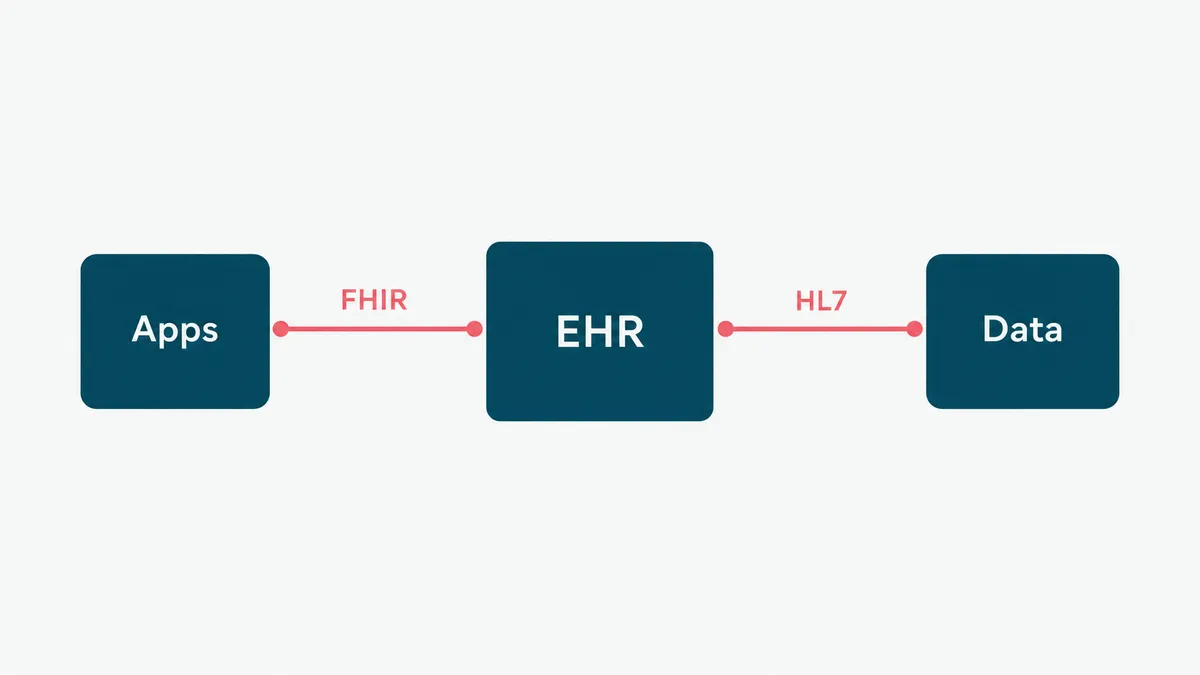
Nobody buys an EHR because they love typing into it. They buy it because it has to talk to labs, pharmacies, imaging systems, billing platforms, and increasingly, AI tools that read the chart faster than the resident on call. This is where the comparison actually gets decided, quietly, in the integration budget nobody puts in the RFP.
Epic has historically kept a tighter grip on who builds on top of it. That gatekeeping now runs through Epic Showroom and Connection Hub, the programs that replaced App Orchard when Epic retired it. The control protects stability. It also means your custom build often routes through Epic's own approval process, which moves at the pace of a queue that occasionally opens a second window. Plan your timeline around the review cycle, not around your own sprint velocity, because the two are not the same clock.
Oracle Health has leaned more open over its history, and Oracle's cloud push is clearly aimed at making third-party and AI integration less painful. Whether that openness holds, and whether the developer experience stabilizes, as the Oracle rebrand completes is the question every CIO is quietly watching. The platform's satisfaction dip in the KLAS 2026 scoring is partly a story about that transition still being in progress.
Either way, both platforms speak HL7 and FHIR, both support SMART on FHIR apps, and both will still need a competent integration team translating "the standard" into "the thing that actually works with your billing vendor." If you want the plain-English version of that standards fight, we wrote it up in HL7 vs FHIR. The short version: standards compliance on paper and standards compliance in production are distant cousins who only see each other at holidays. The federal interoperability rules from the Office of the National Coordinator set the floor. Your interface engine decides whether you clear it.
Cost, contracts, and the total bill nobody quotes upfront
Neither vendor publishes pricing, which tells you everything about how "flexible" that number is expected to be. What buyers consistently report, and what your CFO should ask upfront, is that the sticker price is the smallest part of the total cost. Implementation services, staff training, data migration, third-party interface fees, and ongoing customization all stack on top of the license.
Epic's model tends to bundle more of the implementation under its own team, which can mean fewer vendors to manage and a bigger single invoice. Oracle Health's more modular history has historically allowed more room for third-party integrators to compete on specific pieces of the build, which can lower cost in places if you have the internal capacity to manage more vendors at once. More flexibility, more moving parts. Pick your headache.
One line item both camps underquote is the integration work after go-live. It does not show up cleanly in either vendor's proposal because it is not really the vendor's line to quote. It is yours. A realistic budget treats that connective engineering as its own program with its own multi-year cost, not as a rounding line under "training." The systems that run over budget usually did not misjudge the license. They misjudged the seams.
Where the market-share gap does show up in cost is the ecosystem around each platform. Epic's larger installed base means a deeper pool of certified analysts, more third-party apps already validated against it, and more peer health systems who have solved your exact interface problem before. That thins your risk on some builds. Oracle Health's smaller and more turbulent recent base can mean fewer proven integrations off the shelf and more first-of-a-kind work, which is not automatically more expensive, but it is more your problem to de-risk. Factor the depth of the ecosystem, not just the license, when you model the total.
Implementation timelines and what breaks along the way
Both platforms run multi-year timelines for full enterprise rollouts. That is not a knock, it is the nature of replacing the system that runs your entire clinical operation while the hospital keeps admitting patients the whole time. You are changing the engine while the plane is, unfortunately, still flying.
What tends to break in these projects is not the core EHR. It is the seams: the custom reporting tool nobody documented, the legacy interface engine held together by one retiring analyst's institutional memory, the third-party scheduling app that "should just connect." Both Epic and Oracle Health rollouts generate a long tail of integration work that outlasts the go-live date by a year or two. Budget for that tail. It is real, and it is the part that actually determines whether staff love or loathe the new system six months in.
The go-live gets the cake and the group photo. The interface that quietly reconciles lab results at 3am for the next two years gets neither, and it is the one that decides whether the project was a success. Weight your planning accordingly.
Where custom engineering closes the gap
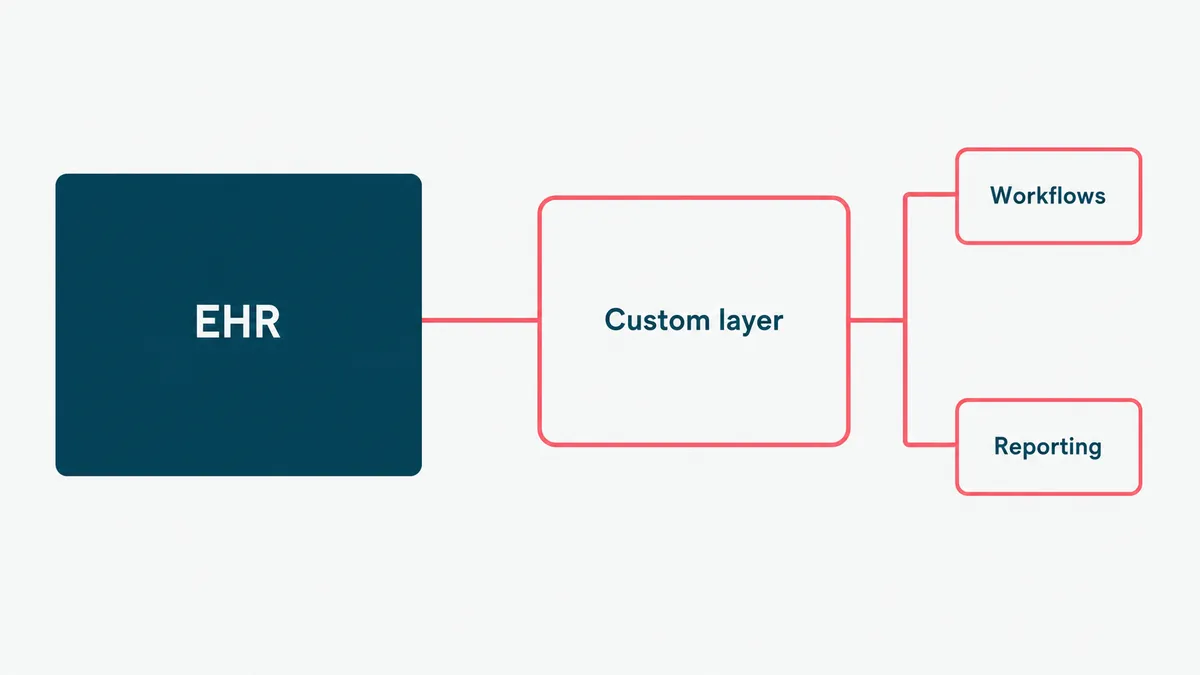
Neither Epic nor Oracle Health is going to build your organization's specific workflow for prior authorization exceptions, your specialty's odd documentation requirements, or the AI-assisted intake tool your clinical staff actually asked for. That is not a criticism of either vendor. It is just outside what an enterprise EHR is built to do out of the box.
This is where a HIPAA-aware engineering team earns its invoice: building the middleware that connects Epic or Oracle Health to the tools your organization actually runs on, writing the FHIR-based integrations that make data portable instead of trapped, and shipping the custom modules that turn "the EHR doesn't do that" into "here's the tool that does." We build exactly this kind of connective work: healthcare API integration between clinical systems, custom modules and platforms on top of an existing EHR, and the EHR-adjacent builds that a health system needs once the core system is live. The glamorous go-live is one day. The integration work is the other 700.
The shape of that work is consistent across both platforms. Patient matching, so a record from the lab feed lands on the right person and not a near-twin. Terminology mapping, so one system's code for a diagnosis means the same thing to the next system down the line. An interface engine that fails loudly instead of silently dropping a message at 2am. An audit trail that can answer, months later, exactly what data moved and when, because in healthcare that question is not optional. Whether the core is Epic or Oracle Health changes the connectors and the approval path, not the discipline. The chart is only useful when everything around it can read from it and write to it safely, and that surrounding layer is what a modern EHR project is mostly made of.
Most health systems do not choose an EHR, they inherit one, then spend the next decade making it fit. That fitting work, the interfaces, the middleware, the FHIR translation layer that lets the chart talk to everything else, is where a project quietly succeeds or stalls. If you are scoping that layer, book a discovery call or estimate your project, and we will tell you straight whether the next move is a new integration, a custom module, or a smaller change to the connective work you already have.