Every founder who asks me what a telemedicine app costs wants a single number. I get it. So does every contractor who has ever been asked what a kitchen renovation costs, right before they say the worst three words in estimating: it depends. (I promise that is the only time I will say it.)
Telemedicine app development cost runs from about $40,000 for a basic MVP to $300,000 or more for a full platform, with most serious products landing between $70,000 and $150,000. The spread is wide because a telemedicine app is not one thing. It is a video call, a schedule, a payment system, and a pile of compliance, and each of those has a dial you can turn up or down.
I run a team that builds healthcare software, so I am not a neutral party here. What follows is the honest version anyway: where the money actually goes, where you can spend less without regretting it, and the one place you should never cut.

What a telemedicine app actually costs
Industry cost guides cluster into three tiers, and after years of scoping these, they match what we see.
A basic app is secure video visits, scheduling, patient and provider accounts, and simple notifications. Call it $40,000 to $70,000, two to three months. A mid-complexity app adds payments, e-prescribing-adjacent workflows, an EHR integration or two, and better admin tooling. That is $70,000 to $100,000. A complex platform, with deep integrations, remote monitoring, AI features, and multi-role workflows, starts around $100,000 and climbs past $300,000.
Those are ranges, not quotes. A quote needs your actual workflow. But if a vendor gives you a firm price before they understand how your clinicians work, the number is fiction with a confident font.
If you want to narrow the range against your own feature list, our software development cost calculator prices a build in about a minute and shows what each choice adds. It takes no email to see the number.
What actually drives the number
Features are the obvious cost, and the unglamorous ones cost the most. Anyone can build a video screen. Building video that holds on a patient's bad hotel wifi, reconnects cleanly, and never drops mid-consult is the expensive part. The boring reliability is the job.
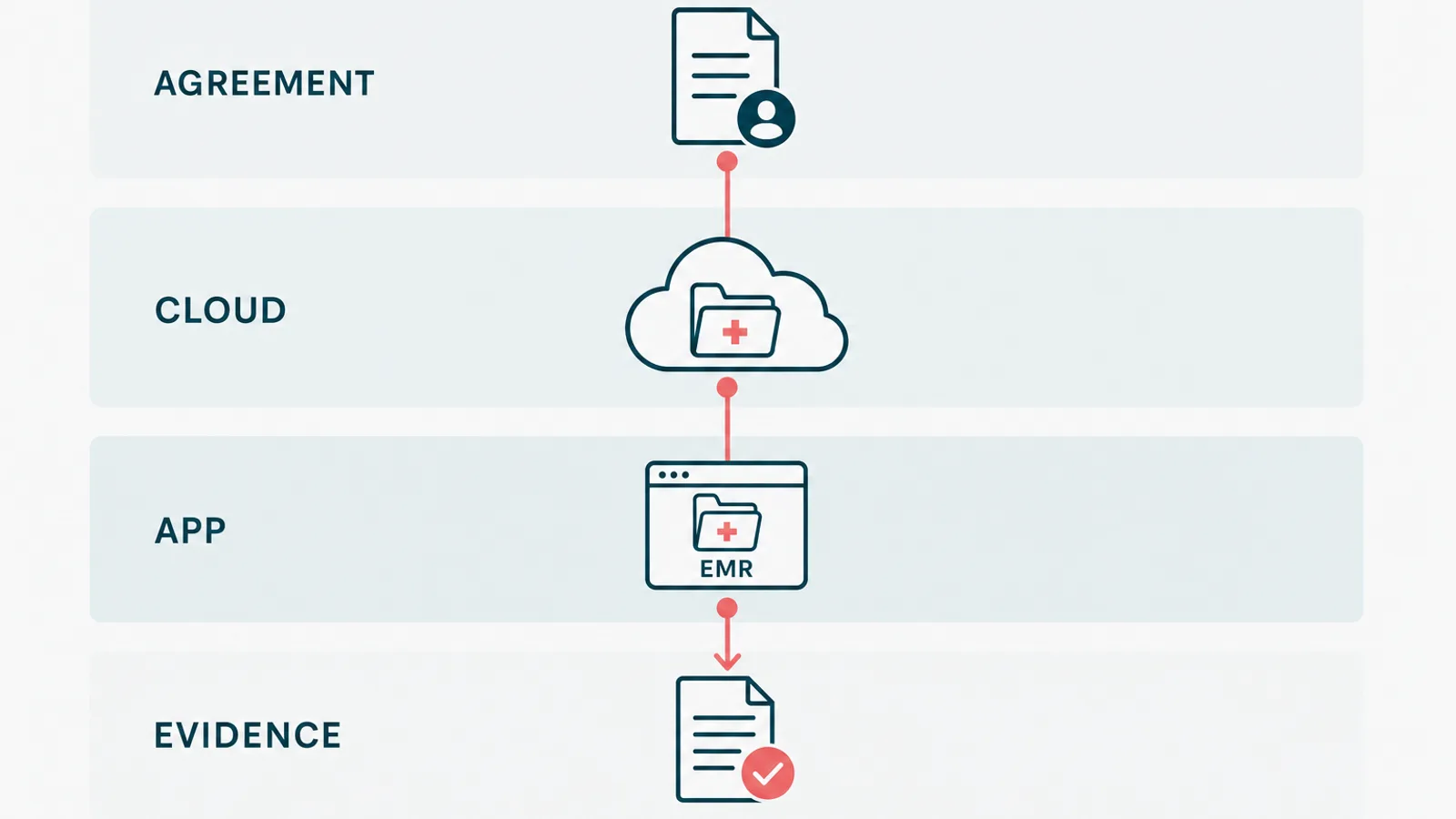
Integrations are the next lever. The moment your app has to talk to an EHR, a lab, or a pharmacy, you are working with someone else's system, on someone else's timeline. We connect these over healthcare API integration using HL7 and the FHIR standard, and the hard part is rarely the code. It is the vendor approvals and the data that arrives messier than the spec promised.
Then there is HIPAA compliance, which is not optional and not free.

The team location nobody mentions until the invoice
Here is the lever that moves the bill more than any feature: where the people building it sit.
For the same senior work, North American developers run roughly $80 to $100 an hour. Western Europe is $30 to $65. Central and Eastern Europe, where my team is, runs about $25 to $50. That is not a small difference. On a six-month build, it is the difference between a $200,000 invoice and a $70,000 one.
The trap is reading low rates as low cost. A cheap team that needs three tries to get HIPAA right is not cheap. The real number is rate times rework, and rework is where offshore horror stories come from. You want the senior rate from a region where senior is affordable, not the junior rate from anywhere. We are a Kyiv team precisely because that math works in a client's favor without cutting the seniority.

The MVP is how you spend less
If you want to cut telemedicine app development cost in half, do not cut features in half. Sequence them.
A real MVP is the smallest version that tests your riskiest assumption with actual patients. For most telehealth products that is video visits, scheduling, and intake, shipped in about six to eight weeks for somewhere around $40,000. You learn whether patients show up and whether clinicians will use it before you spend on the billing engine, the analytics, and the seventeen settings screens.
We build this way on purpose. Ship the core, watch real usage, then add the rest once the workflow has earned it. The features you were sure you needed have a way of looking optional once a patient is actually in the chair.

The costs nobody puts on the slide
The sticker price is the development. The total cost of ownership is the part that arrives later, and a good partner names it up front instead of letting you find it.
Compliance and security are a real line item, usually $10,000 to $30,000 of the build, more if you start late. App-store review for a medical app is slower and stricter than for a to-do list. Third-party services bill monthly: video minutes, SMS, payment processing, hosting. And software is never finished. Budget for maintenance, because the alternative is a platform that quietly rots until the day it matters.
None of this is a reason not to build. It is a reason to build with someone who tells you the whole number, not the flattering half.

Should you build it at all
This is the section the agencies bury, so here it is near the top of the back half. Most telemedicine ideas do not need a custom app.
If an off-the-shelf telehealth tool covers your visits, buy it. It is faster, cheaper, and already compliant. We turn away work that an existing product would handle better, because the fastest way to lose a client is to sell them a build they did not need. Custom telemedicine software earns its cost in exactly one case: when your workflow, your compliance, or your integrations have outgrown what the standard products can do.
We learned where that line sits the hard way. We built a HIPAA-aligned platform for a healthcare wellness company, with patient intake, clinical workflows, AI lab analysis, and billing, all under real regulatory scrutiny. The parts that justified custom were the integrations and the compliance, the exact things no off-the-shelf tool would bend to. Everything else, we would have told them to buy. Honest scoping is cheaper for the client and, it turns out, the reason they stay.
That is the one place you never cut, by the way: compliance. A telemedicine app handles protected health information, so HIPAA-compliant development is the floor, not an upgrade. Retrofitting it onto a finished app is the most expensive way to get there, and an audit is a bad time to learn that.
So what should you budget
Plan for $40,000 to $70,000 to prove the idea with an MVP, and a path to $100,000-plus if it works and you keep going. If you want the full custom picture, our telemedicine software development page walks through what we build. Then send the actual shape of your problem to someone who will scope it honestly, including the verdict that you should buy instead of build.
We reply to those with a real estimate, usually in three to five business days, and sometimes with a recommendation that costs us the project. If you want the second kind of answer, email us. We will also, probably, make one bad joke about your CSV exports. Consider that included in the estimate.